CAG raps DJB for failing to repay Rs 66,595 crore loan
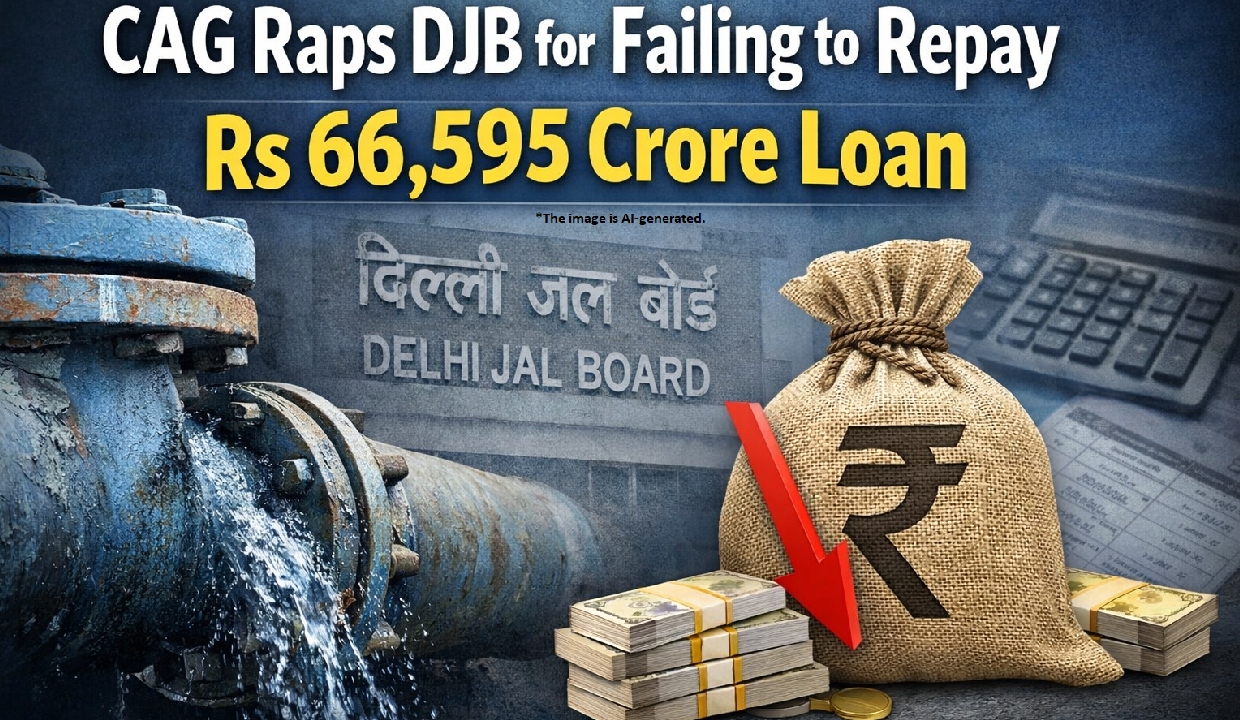
The Comptroller and Auditor General of India (CAG) on Wednesday rapped the Delhi Jal Board (DJB) for failing to repay loans worth Rs 66,595 crore accrued over a period of 10 years and recommended that it explore ways and means for the collection of the huge amount of dues outstanding from the consumers to improve its financial position.
The audit noted that the outstanding loan of DJB increased from Rs 25,140 crore (April 2017) to Rs 34,540 crore (March 2022). Moreover, the interest on the accumulated loan was Rs 32,055 crore (March 31, 2022). However, DJB had not repaid any loan to the Government of the National Capital Territory of Delhi (GNCTD) since 2013-14, and the total outstanding loan and interest was Rs 66,595 crore as of March 2022.
The CAG report on DJB was tabled in the Delhi Assembly. In its reply to the auditor, the DJB stated that it is a non-profit organisation with the main objective of supplying water to more than 26 lakh consumers of Delhi, which comes under an essential household service.
To provide a water supply, the Delhi Government grants loans to DJB because the income of DJB from the supply of water is not enough to repay the loan amount; therefore, it has requested the Government to convert the loans into grants. The decision is still pending with the Delhi Government. The auditor rejected the DJB reply, saying this is not acceptable, as it did not make rigorous efforts to either periodically revise the water/sewage charges or make efforts for the recovery of dues pending from the consumers in order to meet its expenses. The matter was referred to the Government in July 2023; a reply has been awaited since April 2025.
The report further highlighted that in 2021-22, there has been a 23 per cent increase in the principal amount (from Rs 4,325.66 crore to Rs 5,335.46 crore) and a 65 per cent overall increase (from Rs 13,123.69 crore to Rs 21,696.89 crore) in outstanding dues from customers, government departments, etc., including the Late Payment Surcharge (LPSC).
Last year, Delhi Water Minister Parvesh Sahib Singh Verma had stated that DJB is staring at an unprecedented financial crisis, with pending water bills of around Rs 1.42 lakh crore across the city.
“In three categories, we have identified that the commercial category has the highest amount of dues Rs 66,000 crore followed by the government category Rs 61,000 crore and then domestic, Rs 15,000 crore,” said Verma. The audit also noted that the total distribution of potable water was 743 MGD (2021-22), against which DJB had billed only 371 MGD (50 per cent). Moreover, only 244 MGD (66 per cent) out of this was billed on the basis of actual metre readings. Thus, 33 per cent of the potable water supplied was not billed as per actual meter readings.
The report highlighted that though the number of active water connections increased consistently and there was an overall increase of about 16 per cent in the number of water connections during the period under review, the quantum rise in water bills was not commensurate with this.
Further, the shortfall in collection of water charges increased from 30.5 per cent in 2017-18 to 50.5 per cent in 2021-22. This, besides being indicative of inadequate effort on the part of DJB to improve revenue collection, also raises questions on the accuracy of the billing process itself.
Audit Summary: DJB Financial Crisis
1. Debt Profile (As of March 2022)
- Total Outstanding Debt: Rs 66,595 crore.
- Principal Loan: Rs 34,540 crore (Increased from Rs 25,140 crore in 2017).
- Accumulated Interest: Rs 32,055 crore.
- Repayment Status: Zero repayment to the Government of NCT Delhi (GNCTD) since 2013-14.
2. Revenue & Billing Inefficiencies
- Non-Revenue Water: Out of 743 MGD produced, only 371 MGD (50%) was billed.
- Billing Accuracy: Only 66% of billed water was based on actual meter readings; 33% was unmetered/estimated.
- Collection Gap: The shortfall in revenue collection worsened from 30.5% (2017-18) to 50.5% (2021-22).
- Customer Dues: Outstanding dues from consumers/departments rose by 65% in a single year (reaching Rs 21,696.89 crore in 2021-22).