
- HOME
- INDIA
- WORLD
- BUSINESS
- STATES
- LAW & JUSTICE
- ENTERTAINMENT
- SPORTS
- VIEWPOINT
- LIFESTYLE
- TECH
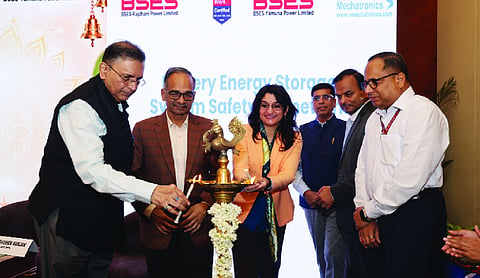
As battery energy storage becomes an increasingly important part of India’s clean-energy transition, BSES recently organised a three-day workshop on the Battery Energy Storage System (BESS) Safety Framework, bringing together power-sector leaders, global safety experts, utilities, fire and emergency services and industry professionals.
The workshop focused on a priority: ensuring battery storage scales up safely, responsibly, and with the right level of preparedness. Discussions covered safety-by-design, early warning and detection, thermal runaway, recognised testing, emergency preparedness, evacuation protocols and first-responder readiness.
The inaugural session was addressed by Ghanshyam Prasad (Chairperson, CEA); Amal Sinha (Director & Group CEO, BSES); Abhishek Ranjan (CEO, BRPL); Sunil Kumar Jha (Director General, FS, CD & HG); Santosh Kumar (COO, BYPL); Alok Kumar (Director General, AIDA); Asko Rajput (Chairman, Standards Committee, BIS); Tanya Singhal (Vice President & Country Head, GEAPP); and Dr Rashi Gupta (MD, Vision Mechatronics Pvt Ltd).
The workshop moved beyond discussions to practical preparedness. A major highlight was a live thermal runaway demonstration in a battery module, followed by firefighting intervention by Delhi Fire Service personnel. The exercise helped participants understand how battery failures can develop and the challenges emergency responders may face.
Global experts Richie Stephen (Senior Standards Project Manager, UL Standards & Engagement), Kurt Vollmacher (Director, Intotech & Fire Safety Trainer) and Dr Judy Jeevarajan (UL Standards & Engagement) shared insights on system testing, failure modes, manufacturing defects, battery ageing, fire safety and emergency response, drawing on experience.
The workshop concluded with nine multidisciplinary teams working through emergency scenarios involving smoke at a BESS site, flooding at an installation, and post-fire dismantling and waste management. The exercise helped participants identify priorities, responsibilities and the safest course of action.
The programme also drew on BSES’ experience with its pioneering 20 MW/40 MWh Kilokri BESS, reinforcing the need to keep safety at the heart of storage growth.