Borders top priority for Govt: Rijiju on claims of Chinese intrusion in Arunachal
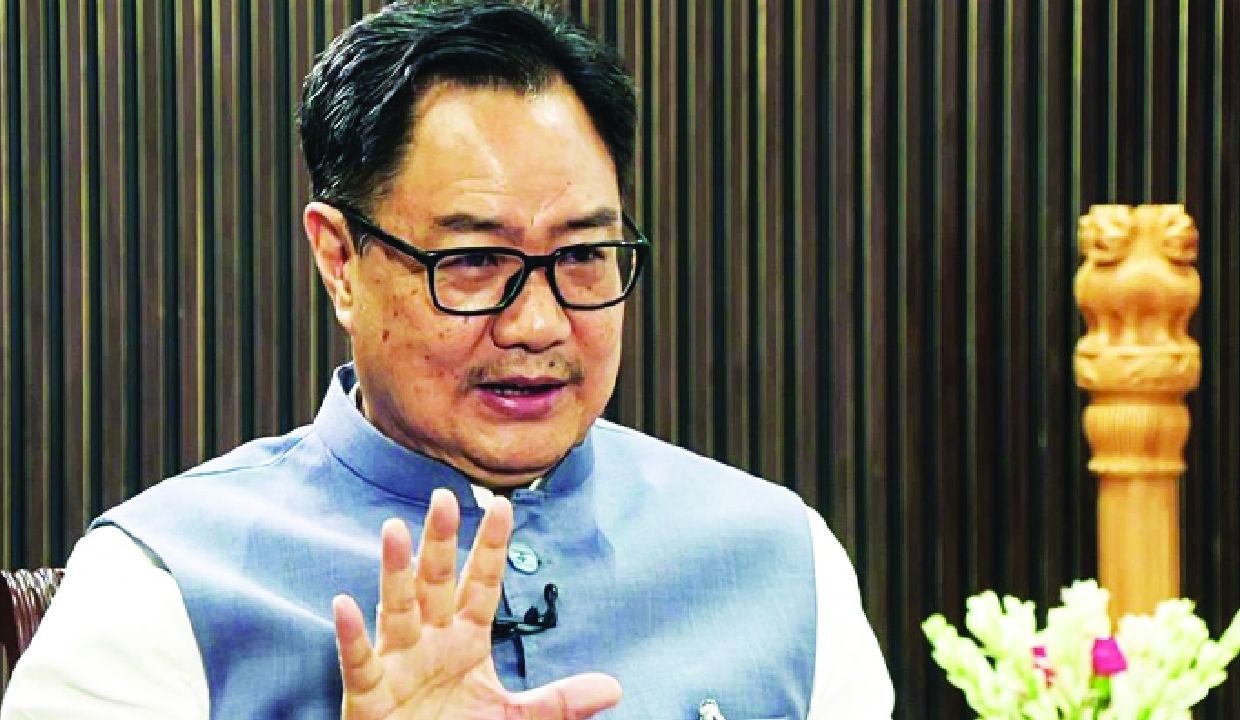
Union Parliamentary Affairs Minister Kiren Rijiju on Thursday said border areas had been neglected in the past but were now a “top priority” of the Narendra Modi Government, as he sought to counter claims of fresh Chinese incursions in Arunachal Pradesh.
Rijiju also invoked former defence minister AK Antony’s 2013 statement in Parliament, saying the Congress leader has then acknowledged India’s historical policy of keeping border areas underdeveloped and that allowed China to steal a march over India in building infrastructure and capabilities along the frontier.
Antony, however, had also made it clear in the same speech that the policy had been abandoned 20 to 25 years earlier and said successive Indian Governments had since been strengthening infrastructure and military capabilities in border areas. He had claimed that the UPA Government, then in its ninth year in office, had done the “maximum” to strengthen such capabilities.
The remarks by Rijiju, who represents Arunachal West in the Lok Sabha, come amid renewed concerns over Chinese military activity in the Upper Subansiri region of Arunachal Pradesh.
“Some people casually commented on border. Border areas are tough but @narendramodi govt is committed to border development. I went to Maza, Galemo, Taksing areas in Arunachal Pradesh to speed up infrastructure works. Borders were neglected in the past but it’s top priority now,” Rijiju said in a post on X.
In a separate post, he targeted the Congress over its record on border infrastructure.
“Amongst the Congress leaders, AK Anthony Ji is very honest. As Defence Minister he admitted the Congress Govt’s policy of not making border infrastructure on the floor of the Parliament,”
he said.
Rijiju was referring to Antony’s remarks in the Lok Sabha on September 6, 2013, when the then defence minister acknowledged that China had built significantly better infrastructure along the border and attributed India’s lag to a policy followed for decades after Independence.
Explaining the historical thinking behind the policy, Antony had said, “Independent India had a policy for many years that the best defence is not to develop the border. Undeveloped borders are safer than developed borders. So, for many years, there was no construction of roads or air fields on the border areas.”
“By that time, China continued to develop their infrastructure in the border areas. So, as a result, they have now gone ahead of us. Compared to us, infrastructure-wise, capability-wise in the border areas, they are ahead. I admit that. It is a part of history,” he had said.
But Antony had gone on to say that the approach was no longer India’s policy and that the change had begun well before the UPA assumed office in 2004.
“But, of late, in the last 20-25 years, the Indian Governments also realised the mistake and changed its policy. Now, we are also strengthening our capabilities in the border areas,” he had said.
“I can tell you, without any exaggeration, that only during the last nine years, as the UPA Government, we have done the maximum to strengthen the capabilities in the border areas. In times of UPA-I & UPA-II, it is being done. And may be the future Governments also will continue the same thing, whoever comes, they will continue the same thing,” Antony had said
.
The latest controversy in Arunachal Pradesh has centred on the Taksing sector. On Wednesday, Rijiju had rejected claims that Chinese troops had penetrated as much as 60 km inside Arunachal Pradesh, but acknowledged concerns among local residents.
“India-China Border issue is a serious subject. Do not make false claim on such sensitive matter. We don’t want to repeat the past mistakes. Govt will address the concern of the local people and protect Indian Territory,” Rijiju wrote on X.
India and China share a more than 3,400-km-long disputed boundary whose alignment is not mutually agreed upon at several places. After reports of tension along the border surfaced recently, the Ministry of External Affairs said peace and tranquillity along the LAC was critical to the overall relationship with China.
“In matters relating to the border areas between India and China, we have always emphasised in discussions with the Chinese side that we consider these issues as most serious,” MEA spokesperson Randhir Jaiswal had said on August 11.
“We have also Stated that the State of the border affairs will reflect on the State of our larger bilateral ties,” he said, adding that maintenance of peace and tranquillity in the border areas was of “utmost importance”.