Bishkek’s real test: What the SCO’s 25th Summit means for India
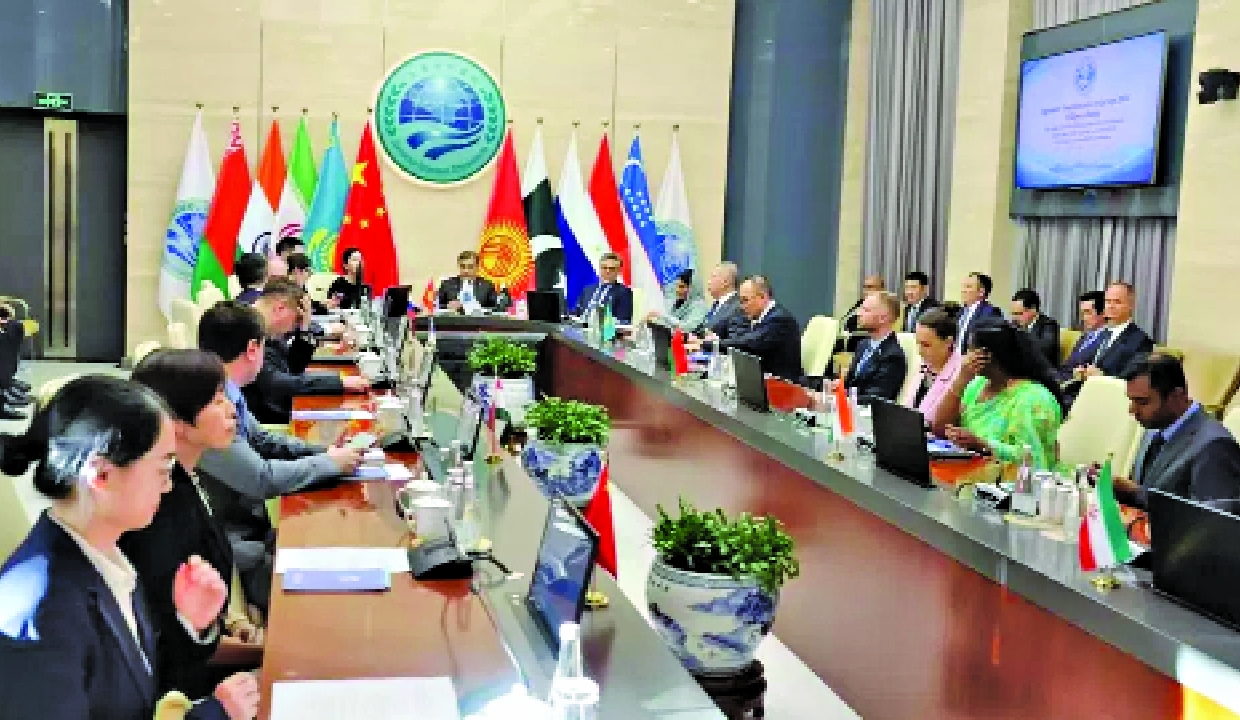
Ten full members, two observers and fourteen dialogue partners under one roof invite an easy reading: another photograph of the world’s shifting power balance. The Shanghai Cooperation Organisation’s 25th-anniversary summit in Bishkek, held August 31-September 1, 2026, resists that shorthand. Behind the ceremony sat a real paper trail: the Bishkek Declaration plus 27 companion documents — 28 agreements, including amendments to the SCO’s 2002 Charter. The volume alone proves nothing, but it signals ambition: to be judged as more than a security forum.
Scale is why this matters. Together, the SCO’s full members, observers and dialogue partners now account for roughly 42 per cent of the world’s population, close to a quarter of its land area, and more than a quarter of global GDP. A coalition that size speaks in many registers at once, a tension India has long managed.
For New Delhi, the clearest gain at Bishkek was collective language on narco-terrorism and organised crime — turning India’s terrorism concerns from a bilateral grievance into a cause backed by a bloc spanning Central Asia, Russia, China, Iran and Belarus. It fits India’s three-word template for the SCO - Security, Connectivity, Opportunity: security as protection from drug trafficking, cybercrime, extremism and insecure borders, not just armies; connectivity as infrastructure that respects sovereignty rather than substitutes for it; opportunity as trade, investment, energy, technology and people-to-people ties.
Institutionally, Bishkek produced two new instruments: a Universal Centre for Countering Security Challenges and Threats, covering all ten full members and fourteen dialogue partners, and an Executive Committee under the SCO’s Anti-Narcotics Centre — backed by a drug-addiction programme, a push against synthetic drugs and precursors (both to 2030), and an information-security plan for 2026-28. None of this proves anything by itself; the test is whether ten states with incompatible intelligence systems can actually share information, act against terror financing and trafficking, and manage the instability radiating from Afghanistan — still only an observer, but a factor every member must weigh.
India pressed a specific argument: anti-terror cooperation cannot be selective. Speaking in the same room as Pakistan’s prime minister, Shehbaz Sharif, Narendra Modi rejected double standards on terrorism and called for dismantling its entire support structure — financing, recruitment, radicalisation and safe havens — rather than isolating any single strand.
A second cluster of outcomes sat outside conventional security: a declaration on nuclear and physical nuclear security, a joint statement on energy cooperation, a programme launching the SCO’s Green Technology Corridor for 2026-30, a biodiversity initiative for 2026-31, and memoranda on information-sharing, climate, crime and energy efficiency. Together, these read as an organisation positioning itself as a governance forum for the energy transition, not merely a counter-terrorism secretariat.
Connectivity received similar emphasis, with the Declaration calling for stronger north-south and east-west transport corridors, simpler cross-border transit, resilient supply chains and digitised logistics. Here India’s interests turn concrete: with overland access through Pakistan effectively closed, Chabahar Port and the International North-South Transport Corridor are its practical workaround — routes into Central Asia, Russia and Europe via Iran. India’s pitch is that connectivity comes with conditions: financially sustainable, free of debt traps, respectful of local environments, and careful never to compromise a third country’s territorial integrity. Making that case through alternatives, not objection alone, is the more persuasive form of dissent.
The Declaration also carried a message aimed past the region: greater representation for developing economies at the UN and international financial institutions, defence of the multilateral trading system, and opposition to unilateral sanctions, asset freezes and secondary penalties that member states see as inconsistent with the UN Charter and WTO rules. So did unrestricted missile-defence deployment and any bid to secure one state’s safety at others’ expense - widely read as a rebuke of Washington’s trade posture, even unnamed.
Multipolarity, however, carries its own warning label. If larger states simply inherit the leverage once concentrated in a single power — at the expense of Central Asian republics, dialogue partners like the Maldives and Laos, or observers like Mongolia — the result isn’t a fairer order, just a reshuffled one. India’s position, consistent with its strategic autonomy, is that a credible multipolar system needs international law, equal sovereignty and transparent institutions, not simply more power centres. The same logic ran through the summit’s language on West Asia: alarm at the humanitarian toll, criticism of the six-month campaign against Iran that disrupted energy and transit markets, and a renewed call for a just Palestinian settlement.
None of this erases the bloc’s internal friction: distrust between India and China, ongoing India-Pakistan tension, deepening Russia-China alignment, divergent stakes in Afghanistan and Iran, and wide gaps in economic capacity among the ten full members. Pakistan takes the chair for 2026-27; its future depends less on membership numbers than on whether the Universal Centre and Anti-Narcotics Centre actually cooperate, whether the long-discussed SCO Development Bank becomes genuinely neutral, whether trade and transport barriers actually fall, and whether members treat terrorism as a principle rather than a convenience.
For India, the SCO is neither a substitute for any power bloc nor a purely ceremonial stage - it’s a working channel into Central Asia, energy security, anti-terror cooperation and the larger push to reshape global governance. What it delivers depends on how consistently India stays engaged with its specific initiatives. Bishkek supplied the declarations and the institutional scaffolding; whether it converts into safer borders, functioning trade routes and shared prosperity — not just a more representative order on paper — is the test still ahead.
The writer is Professor at Center for International Politics, Organisation and Disarmament, School of International Studies, Jawaharlal Nehru University; Views presented are personal.