Beant murder case: SC seeks IB input on Hawara’s jail shift
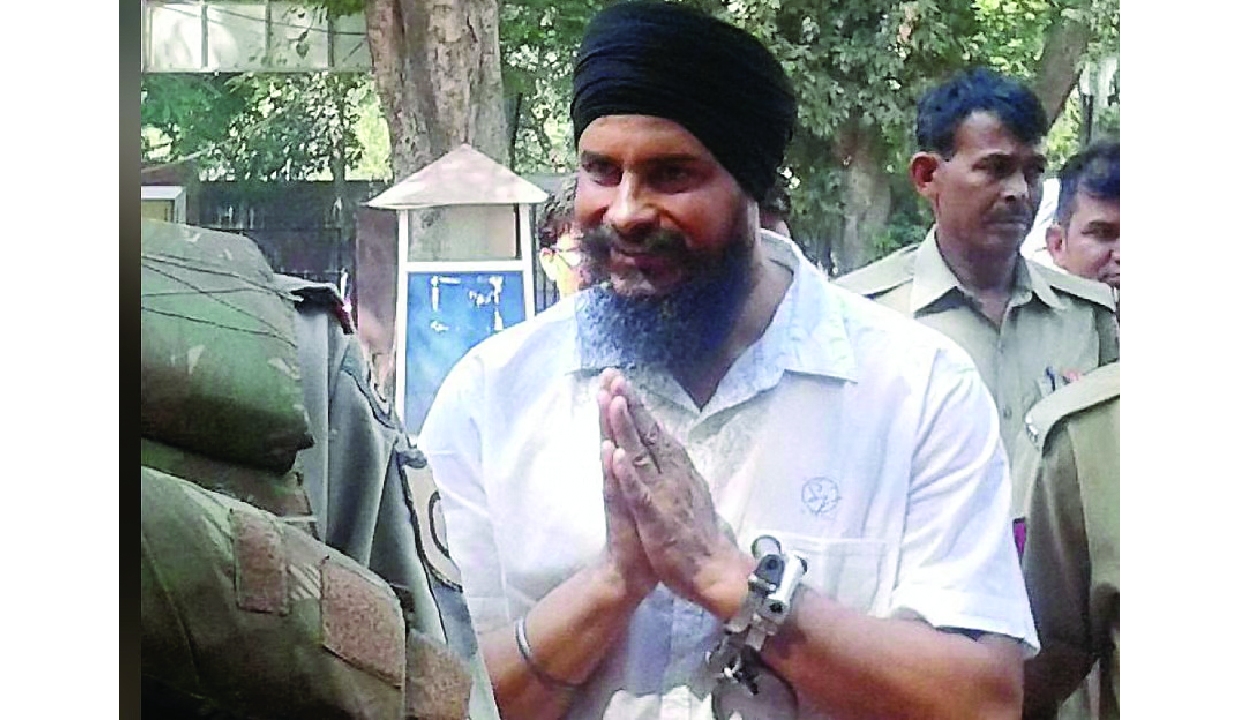
The Supreme Court on Tuesday directed the Delhi Government to seek inputs from the Intelligence Bureau on Beant Singh murder convict Jagtar Singh Hawara’s plea seeking his transfer from Delhi’s Tihar jail to any prison in Punjab.
The Babbar Khalsa terrorist is serving life term in the case related to the killing of the former Punjab chief minister in 1995.
A bench comprising Justices M M Sundresh and PB Varale said these are sensitive matters and it was not in a position to go against the advice of the state Government.
Additional Solicitor General Aishwarya Bhati, appearing for the Delhi Government, informed the top court that Hawara was involved in a jailbreak and his death penalty was converted to life imprisonment in the murder case.
Contending that transfer may increase chances of his escape, Bhati referred to an advisory by the Ministry of Home Affairs on transfer of high-risk prisoners.
She also referred to an affidavit filed by the Punjab Government, and said law and order situation in Punjab will be affected if he is transferred. Bhati said Hawara has been convicted in a case for digging a tunnel in the Chandigarh jail.
Senior advocate Colin Gonsalves, appearing for Hawara, submitted that the CM was assassinated 31 years ago when he was just 21 years old.
“My mother is very old, 82 years old and in serious condition. He is seeking transfer to Punjab high security prison and not going to be released,” Gonsalves said, adding that he has an unblemished record in jail. The top court then remarked, “When you have an ideology... we don't know how it will emanate...Every sinner has a future.. See, people say if you kill one person you are a murderer and if you kill 1,000 persons you are a conqueror. So that is the difference. He (Hawara) may mellow down and be a changed person but what may trigger him after that we cannot say.”
The apex court then posted the matter after four weeks. On September 27 last year, the apex court issued notices to the Centre, Chandigarh administration and the Delhi and Punjab Governments on Hawara’s plea. Hawara is serving imprisonment for the rest of his life in the case related to the blast at the entrance of the civil secretariat at Chandigarh on August 31, 1995, in which Beant Singh and 16 more people were killed.
The plea filed in the apex court said Hawara’s conduct in prison has been without blemish except for the jailbreak on January 22, 2004, when he had escaped and was later arrested. It said he should be transferred from Tihar Jail in Delhi to any other prison in Punjab as there is no case pending against him in the national capital.
Hawara, Paramjit Singh Bheora, Tara and a murder convict Devi Singh had escaped from Chandigarh’s high-security Burail Jail in January 2004 by digging a nearly 100-feet-long tunnel.
Hawara and Bheora were re-arrested within the next two years. Tara, a proclaimed offender in this case, was arrested from Thailand, while Devi Singh is absconding and has also been declared a proclaimed offender. “Petitioner (Hawara) is currently serving his life imprisonment till the rest of his life in a case registered in the state of Punjab... He is a native of state of Punjab, Fatehgarh Sahib district, and ought to be confined in a prison in Punjab,” it said.
According to the plea, the petitioner had 36 false cases against him after the murder of Beant Singh and he has been acquitted in all except one. One person convicted in the same case and also part of the jailbreak has been shifted from Tihar to a jail in Chandigarh, it said.
“The mere fact that the petitioner was considered a high-risk prisoner years ago is not a good enough reason today to keep the prisoner in Delhi and not shift him to Punjab,” it said, adding his daughter is in Punjab.
“The question that arises in this case is whether a person who has been accused of committing a murder in the context of serious social upheaval where tens of thousands of young Sikhs were extra-judicially executed by the state police on the instructions of the deceased Chief Minister Beant Singh, which offence has been characterised as exacerbated by his unsuccessful jailbreak attempt, but who has for the last 19 years led a life in prison which is without blemish can seek an order from this court for transfer to a jail in Punjab,” the plea submitted.
In March 2007, Hawara was sentenced to death by a trial court in the case.
The Punjab and Haryana High Court in October 2010 commuted his sentence to life imprisonment with a direction that he shall not be released from jail for the rest of his life.
Hawara’s petition said the appeals filed by him as well as by the prosecution against the High Court verdict are pending in the apex court.
Panaji, Oct 13 (PTI) The absence of a voter’s name from the draft SIR roll does not mean that it has been deleted, the Election Commission of India (ECI) told the Bombay High Court here on Tuesday, as the court reserved its verdict on a writ petition filed by a Goa resident.
A Special Intensive Revision is a fresh preparation of the electoral roll and not a Special Summery Revision (SSR) where the roll is only updated, ECI lawyer Senior Advocate Ashutosh Kumbhakoni told the Goa bench of the High Court. After the arguments concluded, the bench of Justices Valmiki Menezes and Amit Jamsandekar reserved their judgement. The petition was heard amid a raging controversy over the SIR and functioning of the ECI.
Six members of Paresh Salgaonkar’s family, residents of St Cruz constituency in North Goa district, had filed the writ petition claiming that their names were deleted from the electoral roll during the SIR.
An SIR is a comprehensive, “de novo” exercise as the electoral roll must be “prepared afresh from the ground up,” while a special summery revision updates an existing roll, the lawyer said. “Absence from the draft SIR roll does not automatically amount to deletion,” said Advocate Kumbhakoni.
As the roll is being prepared afresh, a name missing from the draft roll has not technically been “deleted”, he said. “The summary revision updates the existing electoral roll based on information received through the prescribed procedure while SIR rebuilds the electoral roll through an intensive process based on the enumeration exercise,” Advocate Kumbhakoni stated.
“According to the submission, the petitioner had not been residing at the address shown in the pre-SIR electoral rolls for eight to ten years,” the ECI lawyer said, and argued that the petitioner also did not apply to change his address, which should have been done before the SIR process began.
“In fact, my lord, this is a classical case which shows the effectiveness of SIR,” Advocate Kumbhakoni said.
The judges noted that they had made it clear right from the beginning that “there is no challenge to the SIR process” itself.
Advocate Vivek Rodrigues, representing the petitioner, said that the enumeration began on November 4, 2025, after which the Booth Level Officer (BLO) visited both the old and new addresses of the petitioner on November 8, 2025.
On November 12, the petitioner contacted the BLO and requested that the enumeration form be given. But the BLO refused, as the “same must be delivered at the address recorded in the electoral roll (which was the old address).”
The petitioner later filled Form 8 to change the address. The ECI informed on December 8, 2025, that the application for change of address had been received, but when the draft roll was published on December 16, the petitioner’s name was missing, the lawyer said.
The BLO told the petitioner that the Form 8 was still under process and had not been rejected.
Subsequently, on January 17, 2026, the petitioner received a letter from the ECI that his application had been forwarded to the Electoral Registration Officer (ERO). January 19 was the last date to file objections to the draft roll.
“On January 21, my application is rejected. So I am neither in the boat nor in the canoe, left in the sea,” Advocate Rodrigues argued.