Bangladesh embassy celebrates victory day, honours 1971 war heroes
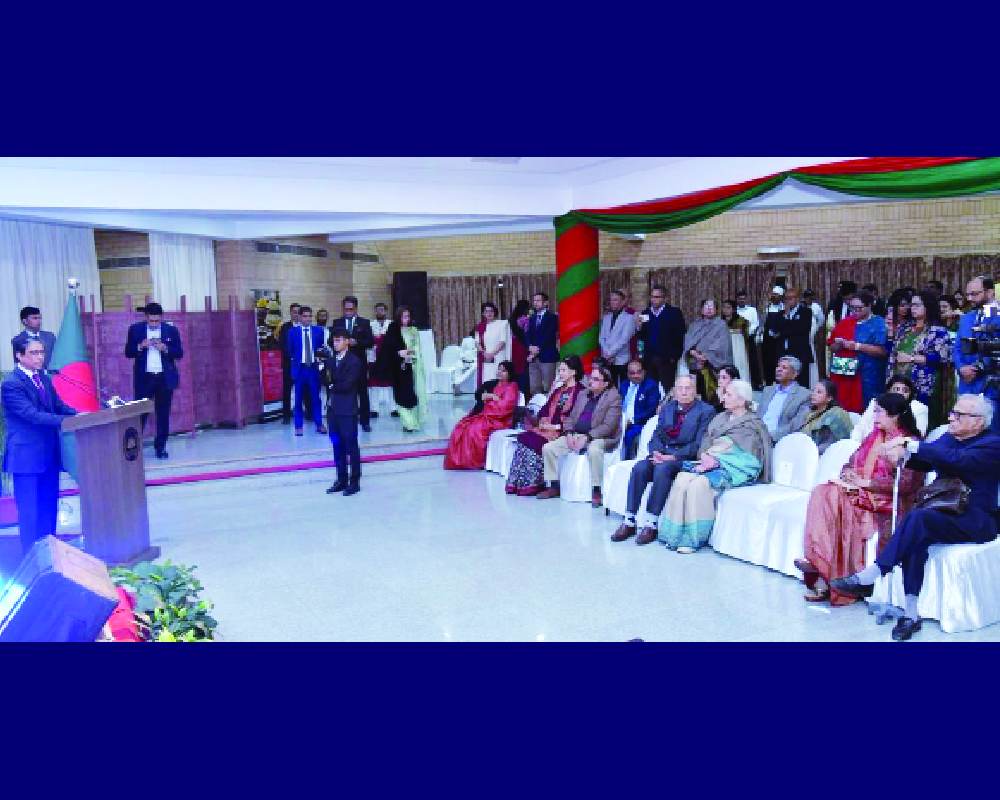
The Bangladesh High Commission in New Delhi commemorated Bangladesh’s Victory Day with a solemn and reflective ceremony, attended by senior diplomats, former officials, and veterans of the armed forces.
The event highlighted the shared history of Bangladesh and India and paid tribute to the heroes of the 1971 Liberation War. Former diplomats and distinguished guests, including Mani Shankar Aiyar, Pankaj Saran, senior diplomatic figures, and veteran members of the Indian armed forces, were present at the occasion, underscoring the enduring bonds between the two nations forged during the Liberation War.
Addressing the gathering, Bangladesh High Commissioner to India, Riaz Hamidullah, delivered an emotional and deeply personal speech, recalling the sacrifices of young Bangladeshi officers whose courage shaped the outcome of the 1971 war.
“Everyone yearns for his or her heroes in life,” the High Commissioner said, reflecting on his childhood influences, including Netaji Subhas Chandra Bose’s essay Torun er Swopna and Thomas Carlyle’s on Heroes and Hero Worship. He noted that these early readings shaped his understanding of leadership and sacrifice. High Commissioner Hamidullah paid tribute to three war heroes who left a lasting impression on him.
He recalled Captain Aftabul Qader, who laid down his life on 27 April 1971 in Khagrachhari during one of the earliest battles against the Pakistan Army while saving his unit.
“Just weeks before his martyrdom, he had been engaged,” the High Commissioner said, adding that Captain Qader’s widow later moved to the United States. “Yet, every 27th April, she and her husband travel all the way to remote Khagrachhari to stand before his grave in quiet remembrance.” He then spoke of Captain Salahuddin Momtaz, who led a daring charge during the historic Battle of Kamalpur on 31 July 1971. Though the Mukti Bahini suffered heavy losses and Captain Salahuddin embraced martyrdom at the age of 24, his courage marked a turning point in the war. “Even the Pakistani commander, moved by his bravery, ordered that the Shaheed Captain be buried with full honours,” Hamidullah said. The Battle of Kamalpur, he noted, continues to be studied in military staff colleges, including Sandhurst. The High Commissioner also remembered Captain Mohiuddin Jahangir, a soft-spoken 23-year-old officer who escaped from Sialkot and fought alongside freedom fighters dressed in a lungi and a fotua. Known affectionately as “Tiger” by the muktijoddhos, Jahangir would recite poems by Jibanananda Das by lantern light before operations. He was martyred on 14 December 1971 at the Battle of Sonamasjid. “Such were men for whom no memorial was erected anywhere in Bangladesh,” Hamidullah said. “Yet, it was their bravery and sacrifice that made 1971 an impeccable people’s war.” He explained that a unique feature of the Liberation War was how the MuktiBahini fought with a very small and young core that constituted a handful of Majors and the rest at the rank of Captains.
Citing General JFR Jacob, the High Commissioner noted that the success of the final assaults owed much to the courage and insight of countless ordinary peasants across Bangladesh. Turning to present-day relations, Hamidullah emphasized that the values and aspirations of the 1971 Liberation War remain deeply embedded in the consciousness of Bangladesh.
He stressed that Bangladesh and India, bound by shared culture, geography, and agro-ecology, have a common stake in peace, stability, and prosperity.
“Bangladesh’s relations with India are deep and multi-layered,” he said, adding that the relationship must go beyond numbers to be grounded in dignity, shared values, mutual trust, and respect. Concluding his address, the High Commissioner called for a future-oriented partnership between the two nations.
“Let us embrace each other in shaping and advancing a framework of trust and understanding where engagements flourish for the mutual benefit of both peoples,” he said.
The event concluded with a renewed sense of remembrance, gratitude, and commitment to strengthening the historic ties between Bangladesh and India.