Assam tops in decline of child marriages
Child marriage in India has dropped drastically, with child marriages among girls down by 69 per cent and the cases among boys by 72 per cent, according to a new report. The report, Tipping Point to Zero: Evidence Towards a Child Marriage Free India, released by Just Rights for Children (JRC), highlights arrests and FIRs as the strongest deterrents against child marriage. Assam leads with an 84 per cent decline in child marriages of girls, followed by Maharashtra and Bihar 70 per cent each, Rajasthan 66 per cent and Karnataka 55 per cent.
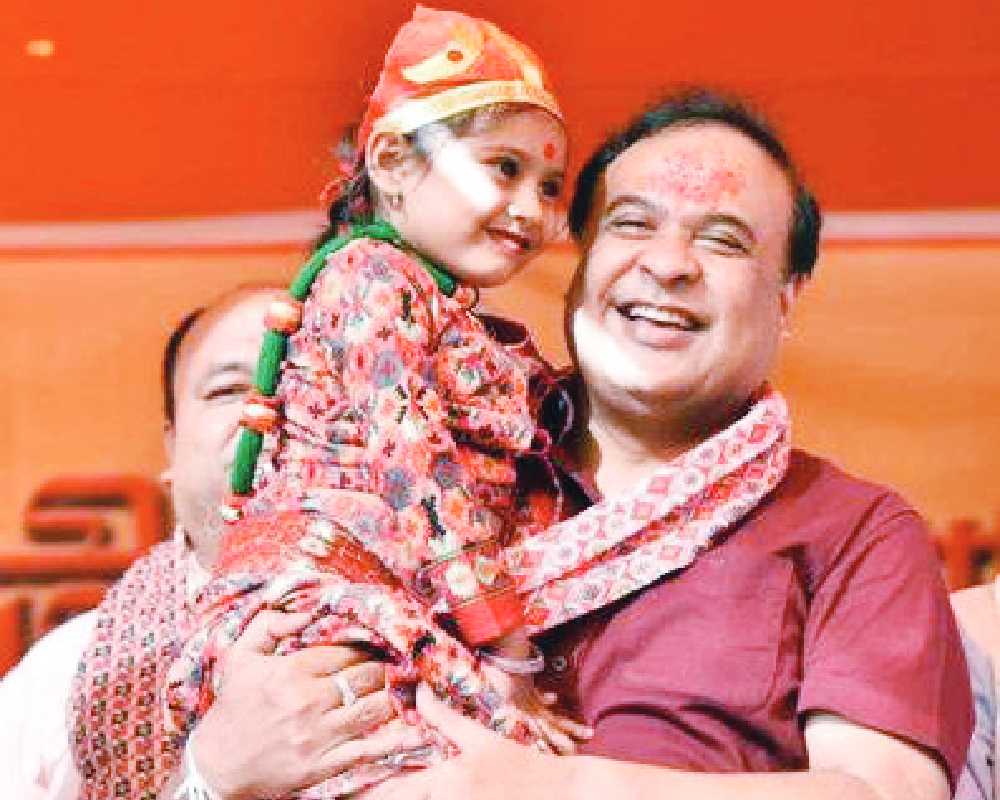
The report was released during a side event at the United Nations General Assembly in New York. It is prepared by the Centre for Legal Action and Behaviour Change for Children (C-LAB), an initiative of JRC Partner India Child Protection. Recognising Assam’s unprecedented success in curbing child marriage, Just Rights for Children also announced the ‘Champions of Change’ Award for Chief Minister Himanta Biswa Sarma. Just Rights for Children is one of the largest networks with over 250 NGOs working for child protection.
The findings mark a monumental shift in the country. As recently as 2019–21, three children were being married off every minute, yet only three cases were reported in an entire day. Today, awareness of child marriage laws is near universal and is a transformation unthinkable just a few years ago. The report highlights that NGOs were the main drivers of awareness about the Centre’s Bal Vivah Mukt Bharat campaign launched in 2024, reaching especially high levels in Bihar 93 per cent, Maharashtra 89 per cent and Assam 88 per cent. Schools played the key role in Rajasthan 87 per cent and Maharashtra 77 per cent.
Emphasising the convergence of all stakeholders and the application of the rule of law to end this crime against children, Bhuwan Ribhu, Founder of Just Rights for Children, said at the report’s launch, “India is on the verge of ending child marriage transcending the fulfillment of a Sustainable Development Goal to prove to the world that its end is both possible and inevitable.
The formula is clear: prevention before protection, protection before prosecution, and prosecution to create deterrence for prevention. This is not just India’s success; it is a blueprint for the world. With strong political will, robust partnerships, community participation, children’s voices at the centre, access to social security, and strict enforcement of the law, a child marriage-free world is within reach.”
Just Rights for Children works closely with the Centre, state Governments, district administrations, law enforcement agencies, community workers and village panchayats to end child marriage by 2030. In terms of education, the report found that in 31 per cent of the surveyed villages, all girls in the age 6-18 years were attending school, but huge disparities were seen in Bihar at 9 per cent and Maharashtra at 51 per cent. Poverty 88per cent, lack of infrastructure 47 per cent, safety 42 per cent and lack of transportation 24 per cent were cited as the barriers in the education of girls.
Reasons cited for child marriage included poverty 91 per cent, to provide safety to minor girls 44 per cent and others cited traditions and norms as the factor leading to the prevalence of child marriage. Just Rights for Children organised the high-level UNGA side event “Creating a Child Marriage Free World: Building the Case for Prevention, Protection and Prosecution” along with the office of Dr Fatima Maada Bio, First Lady of the Republic of Sierra Leone and President of OAFLAD, the Permanent Mission of Sierra Leone and the Government of Kenya, in partnership with the World Jurist Association and Jurists for Children Worldwide.
Other speakers at the event included Dr Najat Maalla M’jid, Special Representative to the Secretary General on Violence Against Children; Åsmund Aukrust, Minister of International Development, Government of Norway; Carren Ageng’o, Principal Secretary, Children Services, Ministry for Gender, Culture and Children Services, Government of Kenya; Isabelle Rome, Ambassador At Large for Human Rights, Government of France; Millie Odhiambo, Member of the Inter-Parliamentary Union; and Kerry Kennedy, President, Robert F. Kennedy Human Rights.