AQI improves to poor after 24 days of very poor air
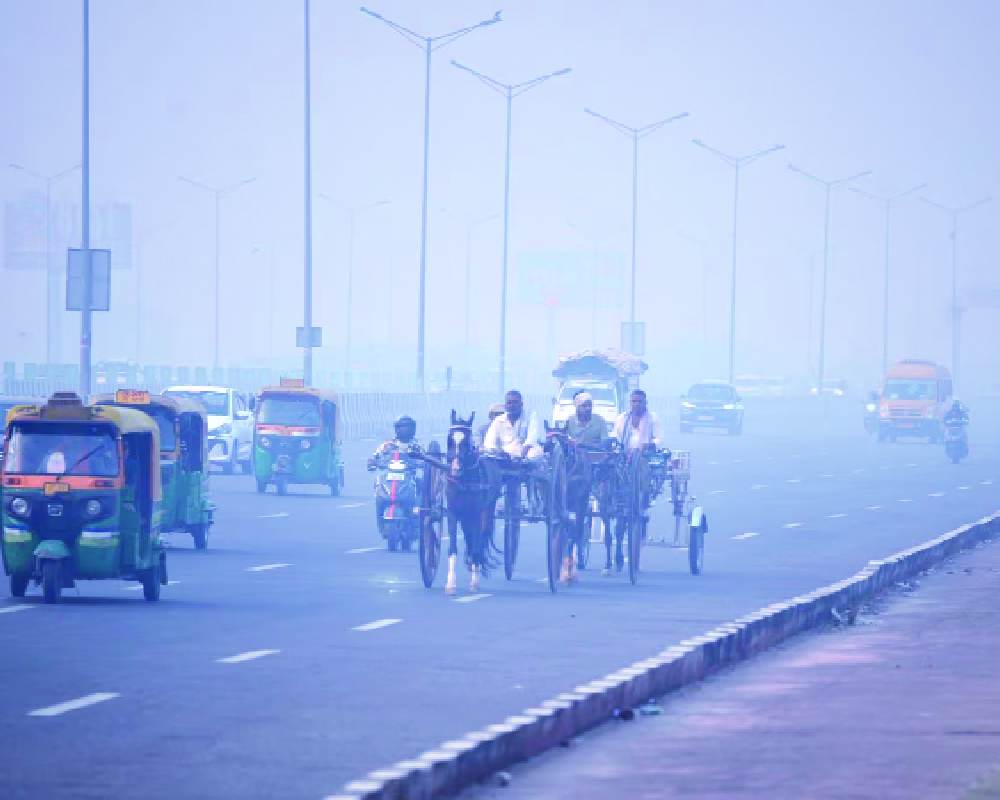
After 24 days of ‘very poor’ air, often bordering the ‘severe’ zone, the air quality in Delhi on Sunday improved to the ‘poor’ category with a reading of 279. The capital city's last recorded Air Quality Index (AQI) in the ‘poor’ category on November 5 at 202, after which the readings turned ‘very poor’, according to Central Pollution Control Board (CPCB) data. The Commission for Air Quality Management (CAQM) on Sunday claimed that Delhi registers its lowest ever average AQI (Air Quality Index) during the 8 years, i.e., from 2018 to 2025 (barring 2020 – the year of lockdown due to Covid).
At 4 pm on Sunday, the 24-hour average AQI was recorded at 279, compared to 305 on Saturday. It stood at 369 on Friday, 377 on Thursday, 327 on Wednesday, 352 on Tuesday, and 382 on Monday. According to the Sameer app developed by the CPCB, no monitoring station in Delhi recorded ‘severe’ air quality on Sunday, similar to Saturday. In contrast, eight stations were in the ‘severe’ category on Friday.
According to the Commission, the improving trend in the overall air quality of Delhi-NCR continues and for the period between January – November during the current year. “The average AQI of Delhi for the period January – November during the current year has been recorded as 187 as against 201 in 2024, 190 in 2023, 199 in 2022, 197 in 2021, 172 in 2020, 203 in 2019 and 213 in 2018 respectively, during the corresponding period,” it said. This period of January – November, 2025, witnessed just 03 days with a daily average AQI more than 400 (‘Severe to Severe+’ categories). There were 11 such days in 2024, 12 days in 2023, 04 days in 2022, 17 days in 2021, 11 days in 2020, 16 days in 2019 and 12 such days in 2018, respectively; Moreover, this year has not recorded any day with a daily average AQI more than 450 (‘Severe+’) so far. There were 2 such days (AQI>450) in 2024, 2 days in 2023, 0 days in 2022, 3 days in 2021, 2 days in 2020, 5 days in 2019 and 0 days in 2018.
The Commission said the period from January – November (upto 27th November) has seen the lowest levels of PM2.5 concentration in Delhi compared to the corresponding period since 2018, which is also at par with the year 2020 (the year of lockdown due to Covid); Delhi has witnessed PM2.5 average of 85 µg/m3 in the current year as against 98 in 2024, 90 in 2023, 90 in 2022, 95 in 2021, 85 in 2020, 99 in 2019 and 103 in 2018 respectively.
“Likewise, the period January – November (upto 27th November) also witnessed the lowest levels of PM10 concentration in Delhi compared to the corresponding period since 2018 (barring 2020 – the year of lockdown due to Covid), recording an average of 183 µg/m3 in the current year as against 205 in 2024, 193 in 2023, 202 in 2022, 200 in 2021, 167 in 2020, 210 in 2019 and 228 in 2018,” it said.
The city did not record a single ‘good’, ‘satisfactory’, or ‘moderate’ air quality day in November. There were three ‘poor’ AQI days, 24 ‘very poor’ days, and three ‘severe’ days, according to the CPCB.
The air quality is expected to remain in the same range over the next few days. With wind speeds likely to remain on the higher side, the AQI is not expected to slip into the ‘severe’ category for at least the next two days, Mahesh Palawat, Vice-President (meteorology and climate change) at Skymet Weather, said.
The Decision Support System of the Indian Institute of Tropical Meteorology, Pune, estimated that vehicular emissions contributed 18.6 per cent to Delhi’s pollution on Sunday, which is projected to be around 18.1 per cent on Monday.