AI: What Indian Universities can learn from the West
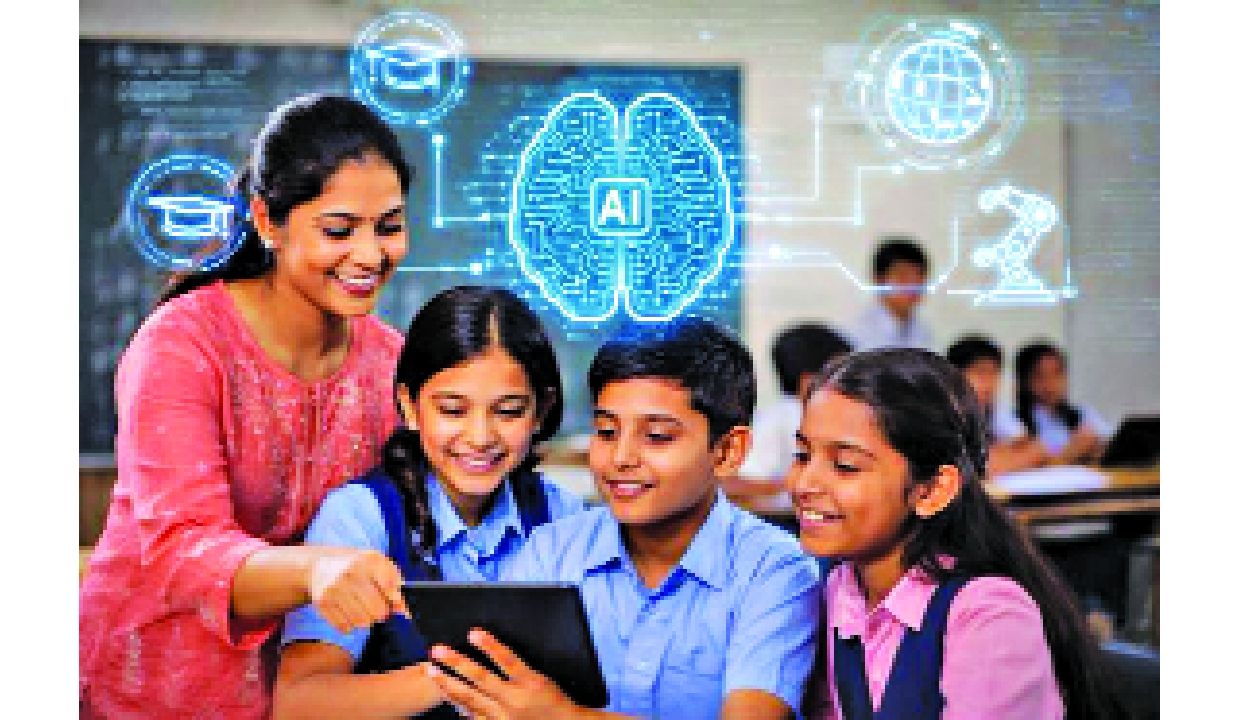
Six years after the National Education Policy 2020 urged universities to break down the walls between subjects, artificial intelligence is becoming the tool for doing it. American and British universities moved earlier, and their experience offers lessons for Indian campuses still deciding how far and fast to go.
The Western experience
Ohio State University has set the most ambitious target. From the class of 2029, every graduate is expected to be fluent in AI and its responsible use within their own discipline. Provost Ravi V Bellamkonda says students will become “bilingual”: fluent in their major and in applying AI within it. A course called “Unlocking Generative AI” is open to all majors, an AI skills seminar is compulsory, and at least six offices guide academic integrity. A history student uses AI for research, an agriculture student for crop data. Neither becomes a computer scientist. MIT built a new college instead. The Schwarzman College of Computing links computing with all five of MIT’s schools, and its Common Ground programme helps departments design classes blending computing with other fields. A standing committee of 29 faculty members reviews proposals. Common Ground awards no major or minor of its own: its subjects sit inside existing degrees, so AI becomes part of a physics or economics degree rather than a side certificate. A separate initiative, SERC, embeds ethics in computing courses.
Oxford chose tools, training and governance together. It was the first UK university to give all students and staff free ChatGPT Edu access, after a year-long pilot with 750 staff members, and it created an AI Governance Group. Departments issue subject-specific guidance. California State University went for scale, rolling out ChatGPT Edu to more than 460,000 students and 63,000 staff members across 23 campuses, comparable to an Indian state university network.
The Indian experience
The push began with regulators. AICTE declared 2025 the Year of Artificial Intelligence, covering more than 14,000 colleges, and promised faculty workshops and certifications.
IIT Madras offers the closest parallel to Ohio State. Its “AI for All” courses on SWAYAM Plus, including AI in Physics, AI in Chemistry, AI in Accounting and Cricket Analytics with AI, need no prior AI or programming experience. In January, it launched them in Hindi, free to access, a step no Western example here has matched.
IIT Hyderabad echoes MIT’s joint teaching: its 12-credit Minor in AI and Humanity has projects co-supervised by liberal arts, design and engineering faculty members. IIT Mandi offers its 24-credit AI minor to other institutions. Oxford’s route has arrived too. In February, OpenAI announced ChatGPT Edu partnerships with IIT Delhi, IIM Ahmedabad, AIIMS New Delhi, Manipal, UPES and Pearl Academy, covering more than 100,000 people. Beyond the elite, the Central University of Haryana will introduce AI courses across all programmes from 2026-27, nearing Ohio State’s model.
Where the approaches differ
Mandate: Ohio State makes AI fluency a graduation outcome. Most Indian institutions offer a minor, elective or online course, so many arts, social science and language graduates will leave without it.
Course design: At MIT, computing and subject faculty members build courses together. In most Indian universities, computer science departments still write them. A chemistry teacher untrained in AI cannot shape “AI in Chemistry”, and a computer scientist alone will miss what chemists need.
Tools and governance: Oxford and Cal State prioritised secure tool access, and Oxford and Ohio State built oversight. In India, access remains confined to well-funded institutions. Most state university students use free consumer tools with weaker data privacy, and many universities have no AI policy, so rules vary from teacher to teacher.
Language: Here, India leads. Free Hindi courses address problem Western universities rarely face and reach colleges that will never sign enterprise agreements.
Scale and teachers: India’s state systems are far larger than Cal State’s, so a national or state-level agreement, perhaps through the IndiaAI Mission, would serve equity better than institution-by-institution deals. And every Western success began with faculty members; short certification programmes do not change how a teacher designs assignments or examinations.
What implementation requires
Educationists point to six steps:
1. Define AI competence as a programme outcome for every degree, in each discipline’s language.
2. Create joint teaching committees on the Common Ground model, with credit flowing through the Academic Bank of Credits.
3. Write an AI policy on assessment, plagiarism, data privacy and research, with room for subject-specific rules.
4. Rethink examinations: take-home essays are easy to generate, while viva voce, in-class writing and project defences test learning.
5. Negotiate shared access to secure AI platforms so district-college students get the protection IIT students have.
6. Expand content in Urdu, Bengali, Tamil, Telugu, Marathi and other languages, and teach ethics inside each subject, where caste, gender and regional bias carry real weight.
Conclusion
The Western universities succeeded through institutional decisions, not better technology: Ohio State set a clear rule, MIT built the habit of joint work, Oxford prepared teachers and governance first, and Cal State used its size to win fair terms. Each is within reach of Indian universities. India has advantages the West lacks: NEP 2020’s credit framework, SWAYAM as a national channel, and proof that subject-linked AI teaching can work free in an Indian language. The gap lies in the middle layer: the state and central universities that teach most Indian students and still treat AI as optional. The next two academic years will decide whether multidisciplinary learning becomes real for them. If academic councils make AI competence part of every degree, train teachers before students and write clear rules, success will look like a botany graduate in Bihar or a law graduate in Kerala who can use AI confidently in her field and judge when it is wrong.
The writer is the former Vice-Chancellor of Jamia Hamdard; Views presented are personal.