A sustainable approach to the ethics and governance of AI

In November 2021, delegates at the UNESCO General Conference in Paris achieved something rare in international affairs. All 193 member states agreed on a single text describing how artificial intelligence should be designed, used and regulated. The Recommendation on the Ethics of Artificial Intelligence became the first global normative framework on the subject.
Nearly five years later, AI tools have entered classrooms, hospitals, courtrooms and Government offices at a pace few predicted. Chatbots draft legal notices. Algorithms screen job applicants and flag welfare beneficiaries. Students submit essays written with machine help. The debate has moved on. Agreeing on principles turned out to be the easier task. Building institutions that keep those principles working for decades is the harder one, and it is where the idea of sustainable governance comes in.
What the world agreed to
The Recommendation rests on four core values. Respect for human rights and human dignity comes first. The text also asks that AI help people live in peaceful, just and interconnected societies, that it protect diversity and inclusion, and that it support the health of the environment and ecosystems.
Ten principles turn these values into working rules. Among them are proportionality and the duty to do no harm, safety and security, privacy and data protection, transparency and explainability, human oversight, fairness, accountability and sustainability. The document also calls for multi-stakeholder and adaptive governance, recognising that a technology changing this fast cannot be managed by a single ministry or a fixed rulebook.
What separates the UNESCO text from the many voluntary codes issued by technology companies is its eleven areas of policy action. Governments are asked to act on data policy, gender equality, culture, education and research, health, labour markets, the environment and international cooperation, among others. The document also draws firm lines. It says AI systems should not be used for social scoring or mass surveillance. It insists that responsibility for decisions affecting human lives must remain with people and cannot be handed over to machines.
Two meanings of sustainability
Sustainability in AI governance carries two meanings, and both matter.
The first is environmental. Training and running large AI models consumes enormous quantities of electricity and water. Data centres are multiplying across continents, and the International Energy Agency has projected that their electricity demand could more than double by 2030. Cooling these facilities draws heavily on freshwater, often in regions already facing shortages.
The Recommendation foresaw this concern. It asks Governments and companies to assess the environmental impact of AI across its full life cycle, from the mining of minerals for chips to the energy consumed when millions of people send queries every hour. A study released by UNESCO with University College London in 2025 found that practical measures, such as using smaller models built for specific tasks and keeping prompts short, could cut AI energy use sharply without a meaningful drop in performance.
For India, this is a practical matter. Power grids in several states already run close to capacity during summer. Groundwater levels in cities that attract data centre investment, including parts of Maharashtra, Telangana and the National Capital Region, are under strain. Growth in AI infrastructure has to be planned alongside water and energy policy, or one will undercut the other.
The second meaning concerns institutional durability. Ethics frameworks have a habit of fading once the launch event is over. Committees meet a few times and then go quiet. A sustainable approach places ethical review inside the routine work of ministries, regulators, universities and companies, so that it continues when political attention shifts to something else. Ethics, in this view, works best as infrastructure, built once and maintained continuously.
From paper to practice
UNESCO has developed two instruments to help countries put the Recommendation into effect. The Readiness Assessment Methodology allows a Government to examine its own preparedness for AI across legal, social, cultural, scientific and economic dimensions. Dozens of countries across Africa, Asia, Latin America and Europe have completed or begun this exercise. The results give policymakers an honest picture of where laws are missing, where skills are thin and where public trust is weak.
The Ethical Impact Assessment is meant for public bodies before they buy or deploy an AI system. It asks direct questions. Who could be harmed? Whose data trains the system? Can affected citizens challenge a decision? How will errors be found and corrected? A municipal body that introduces facial recognition, or a state department that uses an algorithm to identify welfare beneficiaries, would answer these questions before signing a contract.
A widening governance gap
Despite this progress, the distance between commitment and capacity remains wide. A small number of countries and corporations control most of the world’s advanced computing power, training data and AI talent. Many developing nations signed the Recommendation without the technical staff, funding or regulatory bodies needed to enforce it.
Global regulation is also fragmenting. The European Union’s AI Act entered into force in August 2024, with obligations phasing in through 2026 and 2027. The Council of Europe opened its Framework Convention on Artificial Intelligence for signature in 2024. The United Nations agreed in 2025 to establish an independent international scientific panel on AI and a global dialogue on its governance. China, the United States and others follow their own approaches.
Companies operating across borders now face different and sometimes conflicting rules. Smaller countries risk becoming rule-takers, importing systems built elsewhere and governed by standards they had no hand in shaping. The UNESCO framework, because it carries the consent of every member state, offers a shared reference point that can help align these separate efforts.
Colombia turns principles into policy
Colombia offers one of the clearest examples of a country putting the UNESCO Recommendation to work. It completed UNESCO’s Readiness Assessment Methodology, measuring its laws, institutions and skills against the standards set in Paris. That review fed into national planning. In February 2025, the country approved CONPES 4144, its National Artificial Intelligence Policy, with 106 actions and an investment of about 479 billion pesos, roughly 116 million US dollars, running until 2030.
Ethics and governance stand first among the policy’s six pillars. The others cover data and infrastructure, research and innovation, talent and digital skills, risk mitigation, and the adoption of AI across Government and business. The Colombian approach is sustainable because ethics runs through every pillar. The policy treats AI as a driver of growth and social inclusion that must also respect the environment, and it gives clear responsibility for delivery to the National Planning Department and the Ministry of Information and Communications Technology.
Colombia’s courts have added another layer. In 2024, the Constitutional Court reviewed a case in which a judge had consulted ChatGPT while writing a ruling. The court held that judges may use AI tools as support, provided they disclose the use, check the output and keep the final decision in human hands. That reasoning follows the human oversight principle of the UNESCO text closely. For a middle-income country with a large rural population and sharp regional inequality, Colombia’s lesson is practical. Ethics lasts when it is tied to a budget and to an agency answerable for results.
Where India stands
India supported the Recommendation in 2021 and has since assembled parts of its own governance architecture. The Digital Personal Data Protection Act, 2023 sets rules on consent and the handling of personal data. The IndiaAI Mission, approved in 2024, aims to expand public computing capacity, build national datasets and support startups. Guidelines on AI governance released by the Government in late 2025 favoured a principle-based approach over a standalone AI law.
India has also worked directly with UNESCO. In January 2025, the Ministry of Electronics and Information Technology and UNESCO began stakeholder consultations under the Readiness Assessment Methodology, with sessions in several cities including Bengaluru and Hyderabad. The India AI Readiness Assessment Report that came out of this process was released at the AI Impact Summit in New Delhi in February 2026, the first summit in this series held in the Global South. For the first time, India has a systematic account of where it meets the UNESCO standard and where it falls short.
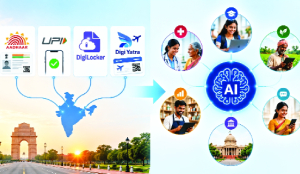
India’s own sustainability model rests on shared public infrastructure. Under the IndiaAI Mission, startups, researchers and universities can rent high-end computing power at subsidised rates from a common pool, which avoids every institution building its own energy-hungry facility. Bhashini, the Government’s language translation platform, makes AI available in Indian languages to people who do not read English. These choices extend the digital public infrastructure approach that India used for payments and identity into the field of AI.
India’s circumstances make the UNESCO principles especially relevant. The country has 22 scheduled languages and hundreds of dialects. AI systems trained mostly on English data can misread or exclude large sections of the population. Welfare schemes increasingly depend on digital identity and automated verification, and a single error can cut a family off from rations or pensions. Agriculture, which employs nearly half the workforce, is seeing early use of AI for crop advice and credit scoring, where biased data could harm small farmers.
Universities carry a particular responsibility here. Engineering graduates write the code that will shape these systems. Ethics cannot sit at the margins of a computer science degree as a single elective. It needs to be part of how students learn to collect data, test models and think about the people their software will affect. Research institutions also need funding to study AI in Indian languages and Indian social conditions, so the country is not dependent on tools tuned for other societies.
What a sustainable approach requires
Experts and policymakers who have worked with the UNESCO framework point to several measures that would give it lasting force.
Permanent institutions come first. An independent body with statutory backing, adequate staff and a clear mandate to oversee high-risk AI would outlast changes in Government. Advisory committees without legal standing tend to lose influence over time.
Impact assessments should become mandatory for public procurement. Any Government department buying an AI system that affects citizens’ rights, benefits or liberty should complete an ethical impact assessment and publish a summary. Green AI standards are overdue. Developers of large models and operators of data centres should disclose energy and water consumption. New facilities should be linked to renewable power and located with water availability in mind. Public literacy deserves sustained investment. Judges, police officers, teachers, doctors and district officials increasingly encounter AI outputs in their work. They need training to question those outputs and recognise when a system is wrong.
Inclusion must be designed in from the start. Systems should be tested for performance across languages, genders, castes, regions and disabilities before deployment. Women remain underrepresented in AI research and development worldwide, a gap the Recommendation specifically asks Governments to close.
International cooperation should extend to shared computing resources, open datasets and joint research among countries of the Global South. Without access to compute and data, ethical commitments in poorer nations remain difficult to implement.
The real test
The test of the agreement signed in Paris will come far from conference halls. It will come when a pensioner in rural Bihar asks why an algorithm stopped her payments and receives a clear answer. It will come when a student in Srinagar uses an AI tutor that understands her language, or when a city chooses a smaller, efficient model over a power-hungry one because the rules require it to count the cost.
The 193 nations that adopted the Recommendation set the direction. Whether they build the courts, regulators, classrooms and power grids to follow it will decide what the agreement means for the next generation.