
At the 12th edition of the Indian Photography Festival (IPF) in Hyderabad, the Bonalu exhibition looks beyond familiar images to explore the festival's more intimate layers: faith, identity, feminine power, community and the transmission of traditions across generations.
"We wanted to bring a deeply rooted cultural tradition of Telangana into contemporary photographic and artistic space," says Phalanvita, one of the two curators.
Around the familiar spectacle of Bonalu, other stories unfold: of people who keep traditions alive, practices that have changed over time, and lives that rarely find their way into the frame.
For photographer Arjun, the project is rooted in childhood memories. Having grown up watching Bonalu rituals, he wanted to document practices that many people may not have had the opportunity to witness.
"I grew up watching these rituals, but not everyone gets to witness them. I wanted to document what I had seen and show it to people who otherwise might never get the opportunity," he says.
Some of the practices he remembers have changed over the years. In certain places in Hyderabad, he says, a bottle gourd is used symbolically in place of an animal during rituals. Animal sacrifice, once more visible in some communities, is now less commonly practised in certain settings.
"There is so much more to Bonalu than what we usually see," he says.

The photographs also invite viewers to consider how a ritual can look different depending on who is watching. Images of animal sacrifice and intense acts of devotion may appear unsettling to those unfamiliar with the tradition. For those who have grown up around it, however, they are part of a larger cultural and religious practice.
Photographer and artist Ramesh Babu Kandukuri approaches the subject as someone who belongs to the community he photographs. His work focuses on the everyday lives and cultural practices of people in Telangana. Through his studio, Samanya Shastra, he seeks to bring these local stories closer to a wider audience.
"People who are part of the tradition may not find it unusual. Outsiders who are unfamiliar with Bonalu might find these images disturbing or different," he says.
For Kandukuri, the relationship between photographer and subject is central. "These are not other people. I am part of them. These are my people. This is my city," he says. "There is no gap between the subject and the photographer."
That sense of belonging is also visible in the work of Veeresh Babu Rama, who has spent nearly three decades documenting Bonalu. His photographs, some dating back to the 1980s, record not only the central rituals but also the people and activities surrounding the celebrations.
"I wanted to capture this because Bonalu is a festival of ordinary people as well. It is not just about the main rituals; it is also about the people who participate in them," he says.
His older photographs offer a glimpse of how the festival has changed, from the nature of public participation to the atmosphere on the streets.
"The environment and the kind of public participation were different back then. Today, almost everyone is occupied with their mobile phones," he says.
Among the other perspectives represented in the exhibition is that of photographer Spandana, who began documenting legs in 2023. Drawing from her experience of living with a physical disability, the ongoing project explores her relationship with her body and the everyday experiences that remain inaccessible to her.
"I am physically disabled by birth. Since childhood, my leg has been different from those of other people," she says.
Her photographs touch on everyday objects and spaces designed around certain bodies but which do not accommodate everyone. The work offers a personal entry point into a larger conversation about access, design and the ways in which the world is experienced differently.
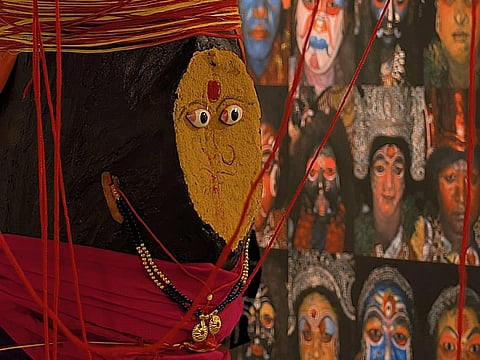
Amid the photographs, a tree installation stands at the centre of the exhibition, drawing visitors into the space. Adorned with a goddess's face and Bonalu pots, it evokes the familiar sight of trees becoming places of worship across Telangana, where people leave coconuts, fruits and other offerings as expressions of faith.
Created specifically for the exhibition, the installation was a deliberate curatorial choice by Vinod and Phalanvita. The two photographers, who regularly document Bonalu, wanted to recreate some of the festival's atmosphere rather than limit the exhibition to a display of photographs. They placed the tree at the centre so visitors could navigate around it before moving on to the images.
"Nature and trees have a very significant place in our culture and spiritual practices. Whether at a temple or in our own homes, there is often a tree or plant that we worship, turning it into a space of devotion," explains Vinod, an environmentalist and the other curator of the exhibition.
He recalls how even a small photograph or idol of a deity placed beneath a tree, sometimes along a roadside, can become a focal point for offerings of coconuts, fruits and other items. For the curators, the tree itself represents the devotion people bring to these spaces.
The installation also involved someone who celebrates Bonalu every year with his family. A friend of the curators spent almost an entire day working on it, recreating the arrangements much as he would for the actual festival.
The tree is also reflected in the photographs selected for the exhibition. Chandrashekhar Singh's frames capture Bonalu celebrations around trees, including one he carefully composed at Vittalwadi in Narayanguda. Having witnessed the festival since he was six, Singh remembers paintings of gods and goddesses appearing almost a week before the celebrations, as the mood in the streets gradually built. Neem and peepal trees in temple premises, smeared with turmeric and vermilion, have stayed with him, as have the thottelas, colourful offerings tied to their branches.
"Each one carries someone's hope, faith and a silent prayer," he says.
The exhibition also brings together objects closely associated with Bonalu, including the rope used by Potharaju and the gavvalu worn by women, adding to the visual details through which the festival's traditions are represented.
"The idea was to bring together the physical experience of the festival and the photographic documentation surrounding it," says Phalanvita.
For Sam Harris, an Australian photographer and educator participating in the festival, the gathering itself is an important part of the experience. Photography can be a solitary pursuit, he says, and festivals give photographers a chance to meet, exchange ideas and learn from one another.
"I think the more intimate something is, the more universal it is," he says, encouraging photographers to look closely at their own lives and relationships rather than choosing subjects simply because they appear interesting.
Across these varied bodies of work, the exhibition offers more than a display of photographs. It creates space for stories that are personal, local and sometimes unfamiliar to find an audience. Whether documenting a ritual passed down through generations, the everyday experiences of a community or the limitations imposed by the built environment, the photographers are asking viewers to look again and, perhaps, a little more closely.
The exhibition is open for visitors until January 3, 2027.