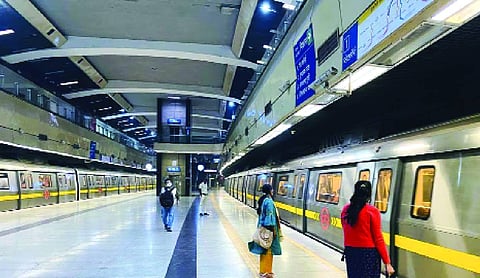

The Delhi Metro Rail Corporation (DMRC) on Wednesday informed the Supreme Court that there was no curtailment or cancellation of metro train services in view of October 10 protests in the national capital and the entry and exit were restricted at just 45 out of the 303 stations.
In an affidavit filed in the apex court, the DMRC also said the number of commuters on October 10 was slightly lower than the ridership on a normal second Saturday which shows the”adverse impact” of protest on the lives of ordinary citizens.
The top court was dealing with several petitions before the Supreme Court in connection with the October 10 protests and detention of those who were out on streets demanding the resignation of Chief Election Commissioner (CEC) Gyanesh Kumar over his handling of special intensive revision (SIR) of electoral rolls and the functioning of Election Commission of India (ECI).
As many as 15 petitions have been filed so far.
The protests called by various youth bodies and political parties in Delhi had led to large scale detentions and assault of protestors as well as journalists and lawyers on October 10 and October 11. The petitions before the Supreme Court include writ petitions, contempt proceedings, habeas corpus pleas and intervention applications challenging restrictions on public transport, alleged unlawful detentions and police action against lawyers, journalists and protesters.
According to DMRC affidavit, over 85 per cent of metro network (258 stations) remained fully operational, accessible and functional for commuters. The DMRC said the entry and exit were restricted at only 45 out of 303 stations, accounting for 15 per cent of the entire network, from 9 pm of October 9 till October 10.
It said the entry and exit regulations were undertaken pursuant to the assessment of law enforcement agencies and in accordance with their directions. “The actual number of passengers who boarded the metro on October 10, 2026 was 32 lakh approx, as against approximately 58 lakh passengers on a normal second Saturday,” the DMRC said.
“This reduction may be attributed to the protest, which appears to have prompted a large number of commuters to refrain from travelling and, consequently, from undertaking their usual daily activities or attending to their business or private employment,” it said.
The corporation filed the compliance report in pursuance to the apex court’s October 9 order.
A bench headed by Chief Justice Surya Kant had also directed the DMRC and others to file a compliance affidavit. The protest call was given by the Cockroach Janta Party (CJP) and some student organisations against Chief Election Commissioner Gyanesh Kumar over alleged irregularities in the functioning of the Election Commission. A separate affidavit was also filed in the apex court by the DMRC chairperson, who said the October 9 order was complied with in letter and spirit.
“Crucially, out of the 45 stations where entry/exit gates were regulated, 14 key interchange stations (including major transit hubs such as Rajiv Chowk, Kashmere Gate, Central Secretariat, Mandi House, Hauz Khas, Dilli Haat-INA, and Netaji Subhash Place) continued to provide full and uninterrupted line-interchange facilities for commuters,” it said. The DMRC said entry/exit of six metro stations were closed from 6 am to 5 pm on October 12 upon receiving communications from police authorities.