
- HOME
- INDIA
- WORLD
- BUSINESS
- STATES
- LAW & JUSTICE
- ENTERTAINMENT
- SPORTS
- VIEWPOINT
- LIFESTYLE
- TECH
Former Supreme Court judge Abhay Oka has said the appointment process for Election Commissioners must remain free from political dominance, underlining the need for robust legal mechanisms and a framework to safeguard the integrity of independent institutions.
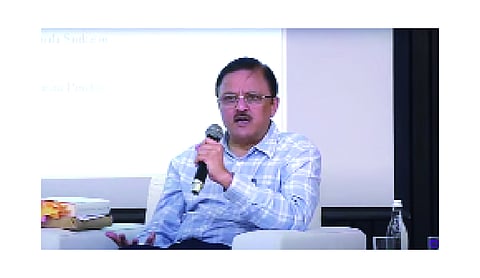
Speaking at a lecture titled “Freedom of Speech and Us” on Sunday organised in Thane, Justice Oka (retd) raised critical questions regarding accountability in high-profile Constitutional appointments. He said it is imperative to establish a system and legal provision ensuring that political hegemony does not dictate the appointment of Election Commissioners, questioning what happens next if an election commissioner, such as Gyanesh Kumar, is removed from office.
“Former Deputy Prime Minister Lal Krishna Advani had proposed a collegium system nearly 14 years ago, which would have included the Prime Minister, Law Minister, Leaders of the Opposition in both the Lok Sabha and the Rajya Sabha, and the Chief Justice of India, to ensure a truly independent selection process,” he claimed.
He reiterated that free and fair elections are the bedrock of democracy. Noting that freedom of speech is the fundamental right of every citizen to express their views and perspectives, he said that an argument must be met with an argument, not with physical force.
“To preserve our nation’s democracy, freedom of speech must be protected, as life loses its meaningful essence without it,” he added. The former Supreme Court judge also criticised what he described as “systematic environmental exploitation”.
“Temperatures in Thane and Mumbai touching 38 to 40 degrees Celsius were unprecedented. Thousands of trees had been cut down across Thane over the past decade to clear space for various projects, the consequences of which citizens are now bearing,” he said.
Lamenting a lack of environmental sensitivity among political leaders, he added that maintaining a scientific temper does not mean going against religion, citing practices like idol immersion in natural water bodies as contrary to scientific stewardship.
Referring to Thane’s proposed circular metro project, the former SC judge said citizens have the right to question whether spending Rs 12,000 crore on metro corridors could alternatively have been achieved at a fraction of the cost, such as by optimising roads and significantly expanding the fleet of the Thane Municipal Transport service.