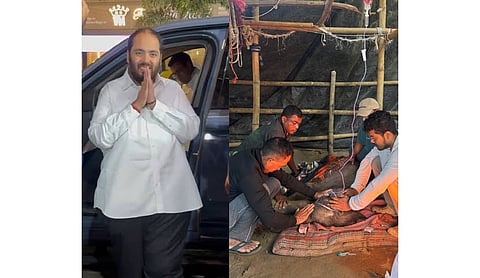

Empathy holds immense importance in today’s times, when the world is grappling with conflicts, crises and uncertainties. With people often consumed by their own struggles and circumstances, looking beyond their immediate realities to care for a fragile living being can be difficult. Yet, Raja’s story sets a beautiful example in the world of philanthropy, demonstrating how India’s individuals can use their resources and influence to protect vulnerable lives. It also offers future generations, particularly children, a meaningful understanding of empathy and how privilege can be accompanied by responsibility.
Born on October 2, 2026, in Gogamukh, Assam, elephant calf Raja’s first few hours of life were marked by an incident that would determine the course of his early journey. His young, frightened mother kicked him, resulting in a complete fracture of his femur. He also missed receiving colostrum, the first milk that provides newborns with essential immunity. What followed was a series of serious medical complications. Raja developed an infection, experienced repeated episodes of severe blood sugar crashes and also suffered from liver stress, pressure sores and an umbilical hernia. His circumstances bring into focus the importance of recognising suffering beyond our immediate surroundings and the responsibility that comes with having the means to make a difference.
Raja’s journey deserves attention because it brings us back to a fundamental question: why do we fight for one fragile life? The answer lies in our ability to recognise suffering beyond our immediate surroundings. Sometimes, the significance of an effort lies in refusing to give up on an individual life simply because its survival is difficult. His circumstances also bring into focus the responsibility that comes with privilege. Access to financial resources, expertise and influence can create opportunities to intervene when help is urgently needed.
How these advantages are used can make a meaningful difference to lives beyond our own. In the case of wildlife, such interventions can mean the difference between an animal receiving basic care and having access to the specialised treatment it needs to survive.
Raja’s journey also highlights the importance of sustained care and the people involved in making it possible. Since October 8, an 11-member team in Assam, comprising three veterinarians, two paravets, five mahouts and one supervisor, has been looking after him. Their efforts have been central to his care through multiple medical complications.
Recognising the need for advanced medical facilities, Anant Ambani made possible the third airlift of its kind in India, facilitating Raja’s transfer from Assam to Jamnagar, Gujarat. He travelled under close, intensive veterinary monitoring and has now reached Vantara, where he is receiving care from its team of experts.
The facility houses the world’s largest elephant hospital, has approximately 80 wildlife veterinarians and provides care to more than 260 rescued elephants. These capabilities offer an important resource for animals requiring specialised medical attention. Raja’s case also brings attention to the wider role of philanthropy in wildlife conservation. Building and maintaining facilities for animal rescue and treatment requires considerable investment in medical infrastructure, research, trained professionals and long-term care.
Maya’s journey highlights how timely intervention and access to specialised medical care can offer hope to even the most vulnerable lives. The 18-month-old orphaned elephant calf was airlifted from Kerala to Vantara in Jamnagar on November 6, 2026, after a fall in July left her with a serious shoulder injury and unable to stand. She was also found to have forelimb fractures, weakened bones and a chest infection. With her condition critical and specialised medical facilities limited locally, a medical board had recommended euthanasia. Her transfer to Vantara opened the possibility of advanced treatment and continued care. She is now undergoing a planned multi-month programme involving mineral supplements, tailored nutrition, medication, hydrotherapy, acupuncture and physiotherapy. Accompanied by care personnel from Kerala, Maya’s treatment also carries the hope that she may one day recover sufficiently to return to Abhayaranyam.
Beyond medical intervention, wildlife welfare also means acknowledging the lasting impact of captivity and providing animals with an opportunity to rebuild their lives. Having spent years performing unnatural tricks under harsh circus lights and the constant threat of punishment, Bahadur endured physical abuse that left him with deep physical and behavioural trauma. At Vantara, his rehabilitation focuses on healing and helping him gradually regain a sense of freedom. Living at the Radhe Krishna Temple Elephant Welfare Trust within Vantara’s Jamnagar campus, he can now move, explore and socialise with other elephants at his own pace, without chains or forced routines. His care also reflects a holistic approach to rehabilitation, bringing together specialised veterinary treatment, tailored nutrition, hydrotherapy, acupuncture and behavioural conditioning. His story is a reminder that rescuing an animal is only the beginning; ensuring it has the opportunity to heal, feel secure and live with dignity is equally important.
Joymoti and Madhuri’s journeys bring into focus the compassion and commitment required to stand by animals through some of their most difficult moments. In July 2026, Joymoti, a 53-year-old elephant, was swept nearly 55 kilometres from Nagaland into Assam by severe floodwaters. Recognising the urgency of her condition and the need for specialised medical attention, Anant Ambani made possible India’s first-ever medical airlift of an elephant in August 2026, facilitating her transfer to Vantara in Jamnagar.
There, she received treatment for multiple wounds and support for permanent blindness in her right eye and chronic lameness in her left hind leg. Her stay was intended to support her medical recovery before returning to her original surroundings. Madhuri, also known as Mahadevi, spent approximately 13 months at Vantara after being moved from Kolhapur in July 2025 for specialised veterinary treatment and rehabilitation. Following a High-Powered Committee order, she returned to Kolhapur in September 2026, with arrangements for continued care and veterinary monitoring. Both journeys reflect an important aspect of empathy: recognising that caring for an animal also means understanding its individual needs and remaining committed to its well-being through every stage of its journey.
India’s industrialists, business leaders and individuals with substantial private wealth have the means to contribute to these efforts. However, wildlife welfare requires more than occasional donations or interventions prompted by individual emergencies. It calls for sustained institutional support and a willingness to invest in causes that may not always receive public attention. When private resources are directed towards such needs, they can help create capabilities that serve animals well beyond a single rescue.
Raja’s transfer is one such instance, where the availability of specialised facilities has made another level of medical care possible.
There is also a larger reflection in what this effort represents. What motivates someone to make such an extensive intervention for a life so vulnerable? Anant Ambani’s involvement reflects a personal commitment to animal welfare, shaped in part by the values instilled by his mother, Nita Ambani, and a wider family association with philanthropy. The significance of such efforts, however, extends beyond the individuals and institutions involved. They offer an example to younger generations of how privilege can be accompanied by responsibility.
In a world where success is often measured through wealth, recognition and material achievements, children must also see the value of extending care, taking responsibility and supporting those who cannot speak for themselves. They learn as much from the actions they witness as from the values they are taught. Seeing people come together to protect an injured animal, even when its recovery remains uncertain, can help them understand that empathy is not merely an emotion but a responsibility that calls for action. Raja’s journey also reminds us that saving a life is rarely the work of one person alone.
The specialists at Vantara’s dedicated elephant hospital in Jamnagar are providing advanced orthopaedic treatment, diagnostics and long-term rehabilitation. Each has played a role in sustaining him through an extremely difficult period.
While the road ahead for Raja may still have its challenges, the continued efforts to support his recovery are significant in themselves. Perhaps that is the larger lesson of empathy: the value of a life should not be determined by its vulnerability or the difficulty of saving it. True empathy lies in extending compassion beyond ourselves and taking action for those who cannot ask for help or repay us. And the true measure of what we have is also reflected in what we choose to do for them
