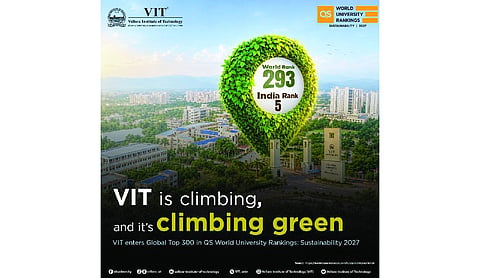

Vellore Institute of Technology (VIT) has secured the 293rd position globally and the fifth rank in India in the QS World University Rankings: Sustainability 2027, marking a significant improvement in its global standing.
According to a press statement issued by VIT Chancellor G. Viswanathan, the university scored 81.2 overall, improving by 59 places from its previous global rank of 352nd. VIT also moved up from seventh to fifth position in India in the latest edition of the rankings.
The QS Sustainability Rankings 2027 assessed approximately 2,000 universities worldwide, evaluating their performance across three key pillars: Environmental Impact, Social Impact and Governance.
Chancellor Viswanathan attributed VIT’s improved ranking to several sustainability-focused initiatives across the campus, particularly in renewable energy, waste management, and biodiversity conservation.
As part of its clean energy initiatives, VIT has installed 441 kW of solar panels over vehicle-parking areas.
The installation generates approximately 650 MWh of electricity annually and helps prevent an estimated 470 tonnes of carbon dioxide emissions.
The university has also introduced measures to convert organic and other waste into renewable energy. Food waste generated from student hostels is recycled to produce 200 kW of electricity, while approximately 15 tonnes of woody waste is converted into bioenergy every year.
In addition to its renewable energy initiatives, VIT has enforced a strict ban on single-use plastics across the campus. The university also maintains a green, tree-filled campus that provides a suitable habitat for native and seasonal bird species.
The latest ranking highlights VIT’s progress in integrating sustainability into its campus operations, with initiatives spanning clean energy generation, waste management, environmental conservation and biodiversity protection.
With its entry into the global top 300 and fifth position nationally, VIT has further strengthened its standing among universities focusing on sustainable development and environmentally responsible campus practices.