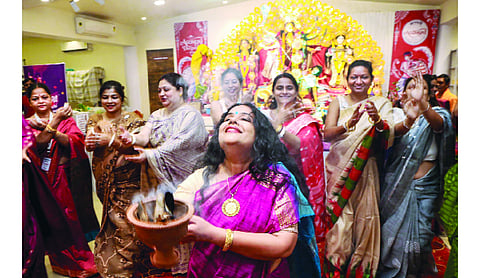

No hablo Ingles muibien … pero, peroLa fiesta de Durga Puja en Calcuta son alucinantes … esexcelente ... (Can’t speak English well but Durga Pujas here are excellent)” Carmen and her friend Mateo exclaimed in Spanish. They have been hopping pandals for the past four days “privado de sueno” (keeping sleep aside).
Like Mateo and his friend Bogdan and Natalia — both of them artists — have come from Poland and have taken a round of 50 pandals, taking down a good many sketches of people, pandals, themes and mythology.
Ever since the Durgas Pujas were included in the UNESCO list of Intangible Cultural Heritage of Humanity, the ‘phoreners’ have been making a beeline to savor and assimilate the Puja spirit and distinct revelry around the ‘homecoming’ of the Mother Goddess. Seldom have they heard of a Goddess (Durga) worshipped as a daughter.
True, the City of Joy has not changed one bit — presenting itself as a grand confluence of faith, art, food and collective exhilaration. Like previous years too, this Durga Puja Kolkata has thrown open an open art gallery of thematic subject matters happily married with mythology, culture, tradition and not least, Bhakti. Leaving behind the unfortunate stampede deaths, the city tended to bounce back to its usual self, displaying traditional Rajbari festivities as also Theme based pandal installations channeling everything from nationalist narratives, classical art forms, cultural heritage, and inclusiveness.
Welcome to a Behala club. Here the theme is titled “KalirAtaleMahamaya” (Mahamaya in the Depths of Kali), reinterpreting the bold visual expressions of 19th-century Kalighat paintings – brilliantly morphing the satirical, colonial-era commentary of Patachitra art into an “immersive backdrop for the contemporary Goddess.”
Cut to New AliporeSuruchiSangha. Here the organisers have shunned the usual regional focus and themed their Pujas around “Utsa” (Origin), serving a grand visual tribute to Shyama Prasad Mukherjee the founder of Jana Sangh, on his 125th birth anniversary. You can find on display his rare photographs, newspaper archives etc.
Shift scene to SantoshMitra Square in central Kolkata patroned by BJP MLA SajalGhosh. Here the concept is based on the partition history of India and nationalist pride. The gigantic electronically lit up silhouette of India in tri-colour sets up and integrates the spirit of the national song “Vande Mataram” and its creator, Bankim Chandra Chattopadhya.
Consider the jamming crowd at 3 am of Ashtamai crawl up steadily with the crowd 10 km upstream to Kashi Bose Lane in North Kolkata where you will find ‘Aadim’ as the theme. The theme celebrates the simplicity of good old days and the age-old relationship between human beings, nature and the earth through the traditional Warli art form. “We are taking you all to our roots in this age of global warming to give a glimpse of harmonious coexistence of man and nature … we hope Mother Durga will inspire all of us to realize the truth and preserve the earth she gave us.”
Come to Kumartuli Park Sarbojonin, where the organisers introduce you to the musical journey of Mother Ganges from Gangotri to the Bay of Bengal.
A few km away, the grand celebrations of the Pujas at Sovabazar Rajbari would enamour you no end. The Pujas are dated back to Raja Nabakrishna Deb and Lord Clive just after the Battle of Plassey. “We don’t have any theme it has been happening this way for the past for about 275 years. Today there are no Rajas but we the family members organizer it … there are about 300 branches of the family and all come together … some from abroad to take part in the festivities — the gold and diamond jewelries including a locket presented by then Egyptian Pharaoh — of the Mother are taken out of the locker during the Pujas,” informed one of the scions of the family.
The Rani Rashmoni Bhawan Puja at Jan Bazar in central Kolkata is no less grand for preserving its traditional grandiose. Rani Rashmoni— one of the richest zamindars of those days —often referred to as LaxmiBai of Bengal, constructed the famous Dakshineswar Kali Temple before taking initiation from Sri Rama Krishna Paramahansa Dev, who even visited the palace during one of the Pujas.
At the famous Daw House, the 170-year-old Puja is started with a shot fired from a 17-mm cannon made by Winchester Repeating Arms Company, one is told.