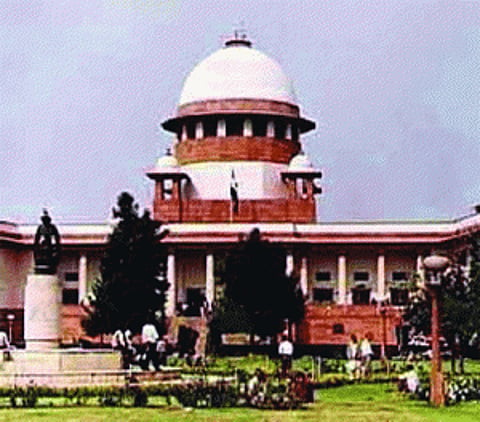

The Supreme Court on Monday asked the law Commission whether sitting Members of Parliament or Assembly could be disqualified when they are chargesheeted in a heinous offence or for filing a false affidavit.
Giving the Commission time till March to submit its report, the Bench of Justices RM lodha and Shiva Kirti Singh requested the Commission to study if there can be any mechanism to verify the veracity of affidavits filed by lawmakers at the time of getting elected. The matter will now be considered on March 10.
The issue arose after a PIl was filed by Public Interest Foundation, which sought urgent steps to decriminalise politics. The PIl demanded steps to block entry of chargesheeted persons into legislative bodies. At present, the law provides only for persons convicted of heinous offences and serious crimes to be disqualified under the Representation of People Act.
The apex court considered the fact that the law Commission was already in the process of carrying out research and preparing a comprehensive report on electoral reforms. The two questions put by the Bench were whether a person can be disqualified on conviction or upon framing of charges by court in heinous crimes or with the filing of chargesheetIJ
Secondly, can there be a disqualification on filing false affidavit and if yes, what can be the mechanism for verifying the affidavitsIJ
On an earlier occasion, the court had sought the view of the Election Commission and the Centre. The EC largely agreed with the PIl and proposed that any person against whom a court has framed charges for offences punishable with a jail term of five years or more should be barred from contesting polls.
It filed an affidavit to suggest, “(After the framing of charges), the integrity and character of the accused is under scrutiny and he ceases to have the requisite excellence and integrity to be considered as a candidate for high public office.”
It backed its proposal by stating that on framing of charges against any accused the allegations and evidence has already met judicial scrutiny. Thus, charges are framed against an accused after the court finds that a prima facie case exists, EC said.