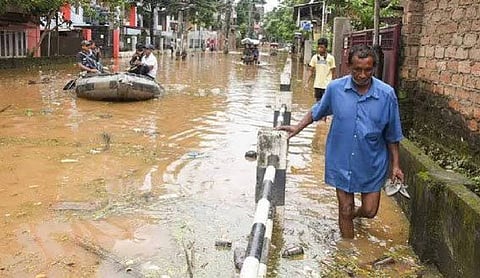

Every monsoon carried the same ritual for the people of Sultanpur, Gadaipur and Jaunapur: the water would rise first at the lowest bend of Mandi Road, then spread until the street itself disappeared, leaving only the tops of scooters and the outlines of stranded autos visible above a sheet of brown water. This year, that ritual finally has an expiry date.
The Delhi Government has sanctioned Rs 25.60 crore for a permanent drainage network and two pump houses at Mandi Road and Bandh Road, aimed at ending one of South Delhi's most stubborn waterlogging problems.
The sanction traces back to a July site visit by PWD and Water Minister Parvesh Sahib Singh, undertaken after heavy rain had left the stretch badly waterlogged. Standing amid the flooded road, local residents told him plainly that this happened every monsoon, disrupting their commutes, their businesses and simply their ability to get through the day.
They asked that it be fixed on priority. Singh promised them a permanent solution. Wednesday's sanction is that promise, delivered.
Until now, the road fell under the Municipal Corporation of Delhi. Under the "One Government, One Governance" principle, responsibility has shifted to PWD, a change meant to collapse the usual back-and-forth between agencies into a single line of accountability, allowing road and drainage work to be planned together rather than negotiated separately.
The engineering itself is built around the geography that created the problem in the first place. Mandi Road connects CDR Chowk to the Delhi-Haryana border via Jaunapur village and runs through naturally low-lying terrain. Rainwater here once had somewhere to go, draining through a natural channel into Haryana.
Rapid urbanisation sealed that outlet, and ever since, each monsoon has turned the road into a knee-deep obstacle course of stalled traffic and crumbling asphalt, with the usual response: temporary pumps rolled out after the damage was already done, offering relief that rarely outlasted the season.
The new project replaces that cycle with permanent infrastructure. On Mandi Road, precast drains will run along both sides, 710 metres on each flank, 1,420 metres in total. Bandh Road will get a 1,920-metre drain on one side. Two pump houses will be built to clear stormwater quickly rather than letting it pool.
Separately, under the South Zone's combined tender, the 4-km stretch of Mandi Road itself will be rebuilt as a strong bituminous road, with financial bids already opened and the work expected to be awarded shortly. "When I visited Mandi Road, residents told me clearly that waterlogging had made their lives difficult for years and that it must be fixed on priority.
I gave them my word, and today we are keeping it," Singh said. "For too long, the people of Sultanpur, Gadaipur, Jaunapur and nearby areas were told to simply live with this problem. Every monsoon, the same pumps came out and the same promises were made."
He said the shift to PWD oversight, combined with the sanctioned funds, would deliver something fundamentally different from what residents had grown used to. "Under One Government, One Governance, PWD has taken charge of this road, and with Rs 25.60 crore sanctioned, we are building precast drains on both sides of Mandi Road, a drain along Bandh Road and two pump houses.
This is a permanent solution, not a temporary patch. At the same time, the 4 km Mandi Road will be rebuilt as a strong bituminous road. The people of this area have waited long enough, and they will see the change with their own eyes," he said.
The choice of precast drain technology is itself designed around the people who will live alongside the construction. Unlike conventional cast-in-place drains, precast units can be assembled faster, cutting down the weeks of dug-up roads and diverted traffic that usually accompany such projects.
Singh has directed PWD officials to maintain strict quality checks and monitor progress closely, with the explicit goal of finishing the work before the next monsoon arrives, so that for the first time in years, the residents of Sultanpur, Gadaipur and Jaunapur might watch the rain fall without bracing for the water that always followed it indoors.