
- HOME
- INDIA
- WORLD
- BUSINESS
- STATES
- LAW & JUSTICE
- ENTERTAINMENT
- SPORTS
- VIEWPOINT
- LIFESTYLE
- TECH
Prime Minister Narendra Modi on Sunday urged citizens to buy products made by local artisans while doing festival shopping, saying such a move will boost the ‘Vocal for Local’ campaign and ensure realisation of the vision of a self-reliant India.
In his monthly radio broadcast ‘Mann Ki Baat’, he said the spirit of ‘Vocal for Local’ is taking Indian products to markets across the world as ‘makhana’ from Bihar is reaching Greece, while ‘arhar dal’ from Karnataka is being exported to the Maldives, opening new global markets for Indian farmers.
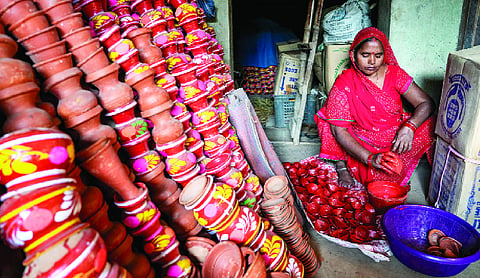
The prime minister noted that during festivals, people buy many things for their family and loved ones. “This time too, while shopping, please give priority to products made by local artisans. Your purchases will boost their enthusiasm,” he said.
Modi said this personal support will advance the ‘Vocal for Local’ campaign, and the more ‘Vocal for Local’ grows, the faster the vision of a self-reliant India will be realised.
“Therefore, I personally urge you to give priority and prominence to products crafted by local artisans,” he said. The prime minister also stressed the importance of good packaging. “Often, when we see something in the market, good packaging makes us pick it up, and we want to learn more about the product. Understanding this, greater emphasis is now being laid on packaging,” he said.
In his radio broadcast, Modi also highlighted the country’s traditional skills that have shaped people’s identity for generations.
The prime minister spoke about the revival of traditional farming practices in Punjab, noting that an organisation named ‘Kheti Virasat Mission’ has started breathing new life into organic farming.
He said the team wanted to promote natural cotton farming in Punjab’s Malwa region and named the initiative ‘Nav-Trinjan’. “You can imagine how great a help this is for the environment. Friends, a few years ago, ‘Nav-Trinjan’ also started a weaving school to pass on the skill of weaving to the new generation,” he said.
During the broadcast, Modi also spoke about people in Tehri Garhwal district of Uttarakhand coming together to breathe new life into the Heval river.
He said that some time ago, the water level in the Heval began to drop, and nearby natural water sources began to dry up. In response, the local administration and villagers launched a drive to save the Heval River; as part of it, they put in place rainwater-harvesting measures, worked to recharge groundwater, and planted a large number of trees.
“Today, these efforts have given the Heval River a new lease of life while also helping rejuvenate dozens of natural water sources,” he said.
The prime minister also highlighted the ‘e-Sanjeevani’ scheme, which uses technology effectively for medical consultations. Modi said that through its vast network, the e-Sanjeevani service reaches even the remotest corners of the country, and the stories of its beneficiaries are deeply moving.
Mann Ki Baat Like Pilgrimage: PM
New Delhi: Prime Minister Narendra Modi called his 12-year monthly radio broadcast, ‘Mann Ki Baat’, a “pilgrimage”, describing it as an opportunity to understand citizens’ efforts closely and pay tribute to their contributions.
In the 139th edition of the programme, Modi also said that through the radio address, he, in a way, worships the nation’s collective power (Lokshakti), which allows him to connect with every family in the country.
“Welcome once again to Mann Ki Baat. Twelve years ago today, on the auspicious occasion of Vijayadashami, we began Mann Ki Baat. Since then, our journey has been continuing without interruption. You are both fellow travellers and guides on this journey,” he said.
The prime minister said Mann Ki Baat has been a “blessed occasion” for him to sing the praises of the hard work, valour, commitment, dedication, and spirit of service of the country’s common people.
“There has been an ancient tradition of pilgrimage in our country. For me, Mann Ki Baat is no less than a pilgrimage to closely learn about the efforts of the people of the country and to bow down to their contributions,” he said. Modi said those who live for society and the nation are pilgrimage sites in themselves.
In these 12 years, he said, many such people have come forward from every corner of the country whose extraordinary work usually misses the attention of society.
“Mann Ki Baat has worked to bring countless such inspiring stories before all of you. Through this programme, I, in a way, worship the nation’s collective power. It allows me to connect with every family in the country,” he said.
The prime minister said he receives hundreds of messages in which people share that after listening to Mann Ki Baat, they felt as if he was sitting among them as a member of their family, conversing with them.
“For me, this intimacy and affection from all of you listeners is an invaluable asset,” he said.