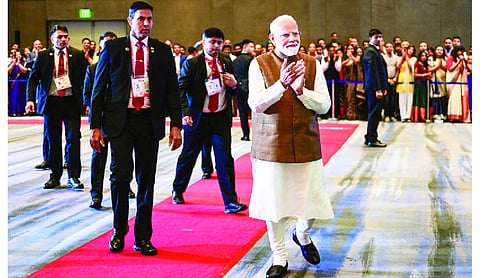

Prime Minister Narendra Modi arrived in Manila, the Philippines, on Monday to participate in two significant regional diplomatic gatherings, highlighting India’s growing commitment to strengthening strategic, economic and maritime cooperation with Southeast Asia and the wider Indo-Pacific region.
During his visit, Modi is scheduled to attend the 23rd ASEAN-India Summit and the 21st East Asia Summit on Tuesday.
The visit, at the invitation of Philippine President Ferdinand R. Marcos Jr, is expected to provide fresh momentum to India’s engagement with ASEAN member states amid increasing geopolitical competition and changing global economic dynamics. The Ministry of External Affairs (MEA) confirmed Modi’s arrival in Manila, emphasising that ASEAN remains a central pillar of India’s Act East Policy and its broader Indo-Pacific vision. Before departing for the Philippines, Modi described India’s partnership with ASEAN as a cornerstone of its regional engagement and an important component of its MAHASAGAR vision, which stands for Mutual and Holistic Advancement for Security and Growth Across Regions.
He highlighted the expanding relationship between India and Southeast Asian countries, which now extends beyond traditional diplomatic ties to include trade, connectivity, technology, maritime security and cultural exchanges.
The Prime Minister is expected to engage with regional leaders to strengthen the existing Comprehensive Strategic Partnership and advance shared priorities, including economic development, regional connectivity and prosperity.
Southeast Asia holds considerable strategic importance for India because of its position along major international trade and maritime routes connecting the Indian and Pacific Oceans. Stronger ASEAN partnerships could help India diversify supply chains, expand trade opportunities and increase its influence in regional affairs.
Maritime security is expected to feature prominently during the discussions. The year 2026 has been designated as the India-ASEAN Year of Maritime Cooperation, reflecting the growing importance of collaboration in securing regional waters. India is seeking greater cooperation in maritime domain awareness, coordinated patrols, combating piracy and addressing illegal, unreported and unregulated fishing.
Such initiatives are important for protecting international shipping routes and safeguarding India’s economic and energy interests. Modi will also participate in the East Asia Summit, an ASEAN-led platform established in 2005 that brings together regional and global powers to discuss economic cooperation, security and international developments.
Its participants include ASEAN members, India, China, Japan, South Korea, Australia, New Zealand, the United States and Russia. The summit will provide India an opportunity to exchange views on regional stability, economic resilience and the evolving Indo-Pacific security environment.
Established in 1967, ASEAN has developed into one of the world’s most influential regional organisations, with 11 members, including Timor-Leste. Its theme this year, "Navigating the Future", underlines the importance of collective responses to emerging challenges.
Modi’s visit also offers an opportunity to strengthen India’s bilateral relationship with the Philippines, particularly in maritime security and regional stability. His interaction with the Indian community will further reinforce cultural and people-to-people connections.
Overall, the Manila visit underscores India’s determination to deepen its Act East Policy, strengthen its MAHASAGAR vision and emerge as a reliable partner in shaping an inclusive, peaceful and prosperous Indo-Pacific region.