
India is steadily expanding its strategic engagement with Latin America, with a particular focus on deepening ties with Peru. In a significant shift towards enhancing south-south cooperation, New Delhi is prioritising the development of a robust economic and diplomatic framework with Lima. Both governments, along with their respective diplomatic missions, are working intensively to lay the groundwork for stronger bilateral trade and investment partnerships.
India views Peru as a key gateway to the Latin American market, rich in natural resources and increasingly aligned with India’s global outreach strategy. The emphasis is on establishing mechanisms to facilitate smoother trade operations, reduce bureaucratic barriers, and open avenues for investment in mining,
pharmaceuticals, IT services, renewable energy, and infrastructure.
Ongoing negotiations on a preferential trade agreement (PTA) are progressing steadily, with both sides keen to finalise terms that will unlock significant potential in bilateral commerce.
Diplomatic efforts are also focused on creating institutional support for Indian businesses looking to enter or expand in the Peruvian market, while simultaneously encouraging Peruvian companies to explore opportunities in India.
For India, Latin America is no longer a peripheral region but an essential component of its global strategic calculus.
Peru, with its dynamic economy and geopolitical positioning, is fast emerging as a crucial partner in that vision.
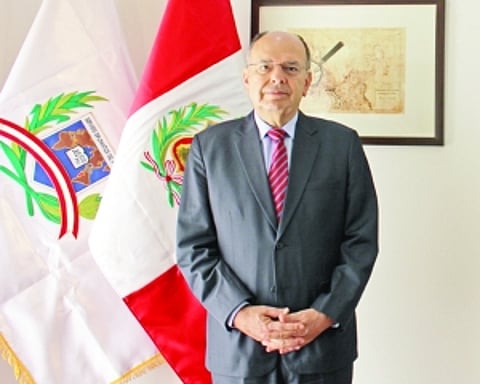
The momentum behind this renewed focus signals a long-term strategic alignment aimed at mutual growth and global relevance. Peru Ambassador Javier Paulinich spoke to Anoop Bose regarding the ongoing deliberations between the two countries.
It is estimated that the Free Trade Agreement (FTA) with India will be finalised in the first half of this year. How important is it for India to achieve this trade agreement with Peru?
India considers it important to finalise a Free Trade Agreement (FTA) with Peru, as it would strengthen its strategic presence in Latin America and diversify its trade relations in the region. In 2024, bilateral trade between the two countries reached approximately $5.7 billion, of which Peruvian exports accounted for about $4.7 billion. Particularly noteworthy is the export of gold from Peru to India, which amounted to $4.2 billion, reflecting the dynamism and potential of this commercial relationship.
Moreover, Peru is positioning itself as a strategic hub for trade in Latin America, thanks to its privileged geopolitical location and the modernisation of its port infrastructure, including the Port of Callao and the Chancay megaport, which will facilitate connections between Asia and the region, optimising logistics costs and distribution times.
Could the FTA that Peru is negotiating with India reshape trade relations in the region?
Undoubtedly, the signing of an FTA between Peru and India has the potential to reshape trade relations in Latin America. By becoming the first country in the region to establish a free trade agreement with India, Peru would consolidate itself as a strategic axis for intercontinental trade in favour of India, as it would provide a tariff-free commercial platform for the rest of the region. Additionally, Peru’s strategic location on the Pacific and its modern port infrastructure position it as a key logistics hub for the distribution of goods throughout South America. In short, this agreement would not only strengthen India’s presence in the region but also foster new investments and greater economic integration with Latin American markets.
What significant change could there be in the flow of investment and exports?
The implementation of the FTA with India could lead to a substantial increase in Peruvian exports, especially in the mining and agricultural sectors. In 2024, agro-exports to India reached a record $30.7 million, with key products including blueberries, avocados, quinoa, asparagus, among others. Furthermore, the agreement is expected to boost new Indian investments in key sectors of the Peruvian economy, such as the automotive and pharmaceutical industries, thereby diversifying the sources of foreign direct investment.
Could trade priorities be rearranged?
Indeed, the conclusion of the FTA with India could lead Peru to reorder its trade priorities, placing greater emphasis on Asian markets. This strategy would allow Peru to take advantage of the opportunities offered by the Indian market, with over 1.45 billion inhabitants, and reduce its dependence on traditional markets.
In which sectors could Peru be competitive with India?
Peru can be competitive in several sectors in the Indian market, particularly due to its abundant natural resources. The elimination of tariffs and other trade barriers could increase Peruvian exports of mining products, metal-mechanics, fishery products, as well as a wide range of agricultural goods.
Which sectors could be highly dynamic for India in Peru?
India’s competitiveness in the automotive, health, pharmaceutical, railway infrastructure, and ship and aircraft construction and repair sectors could be highly beneficial for Peru. Tourism is another promising sector that could benefit from the FTA. Peru is an increasingly recognised destination, which could generate investment opportunities in the film industry for Bollywood productions and even in the tourism industry itself.
To what extent would a trade agreement with India facilitate a more intensive expansion of Peruvian exports?
A trade agreement with India would eliminate tariff and non-tariff barriers, facilitating access for Peruvian products to the vast Indian market. This would allow for a more intensive expansion of Peruvian exports, especially in sectors such as agriculture and mining, where Peru has already proven competitive.
Although gold, copper, and silver are the stars of Peruvian exports to India, what other products could also shine brightly?
The high quality of Peruvian agricultural products-such as avocados, blueberries, grapes, maca, cacao, coffee, asparagus, Brazil nuts, citrus fruits, and palosanto-positions them as promising in trade with India. Other minerals like zinc and lead, which are used in the production of inorganic chemicals, also have significant export potential.
Is Peru emerging as one of the most attractive countries for Indian investment?
Yes, Peru is positioning itself as one of the most attractive countries for Indian investment. The negotiations of a Free Trade Agreement seek to strengthen economic and commercial cooperation between the two countries. Peru offers investment opportunities in various sectors, including infrastructure-such as airports, ports, and railway networks-where India can contribute its expertise and technology.
Is India a strategic alternative for Peru in the context of the trade war between the United States and China?
In the context of global trade tensions, diversifying trade partners is essential not only for Peru but for many other countries. India presents itself as a strategic alternative, offering a growing market and opportunities to expand Peru’s presence in Asia. Signing the FTA with India would strengthen Peru’s economic resilience, mitigating risks associated with trade disputes between major powers.