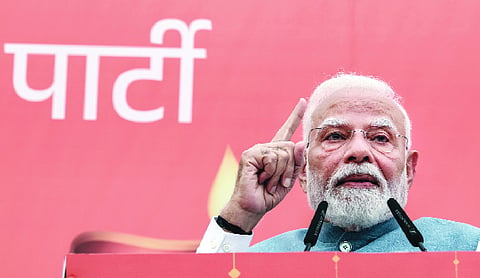

Prime Minister Narendra Modi on Thursday said the past decade was the first since Independence in which Indian agriculture grew more than 4 per cent a year, and that many small farmers have come out of poverty during this period. Speaking at the Kisan Tak Bharat Agriculture Conference organised by the India Today Group, the Prime Minister said two facts show the link between agriculture and development.
“A World Bank report says that in just 12-13 years, 50 crore people in India have overcome poverty, and poverty has fallen fastest in villages. Many small farmers have come out of poverty.”
“In the past decade, agriculture has grown at more than 4 per cent a year. This is the first decade since Independence in which the sector has done so,” he said. “Unfortunately, people stuck in the angle and agenda of the news do not see these achievements.” Calling agriculture “our culture, our tradition and the basis of our social life”, the Prime Minister said a developed India was not possible without making farming “smarter” and farmers “self-reliant”.
Modi described agriculture as the main stream among the “seven streams of power” he had mentioned from the Red Fort for Viksit Bharat. Taking a dig at earlier governments, Modi said those who ran the country for decades were “satisfied” that farmers had filled the grain stores, even as the market, technology, weather and people’s food habits changed. “It is not enough to fill the grain stores,” he said, adding that farmers needed new skills to keep pace and that this has not received attention. In the past decade, he said, the country had taken steps to match that pace. On input costs, Modi said the Centre has spent Rs 16 lakh crore on fertiliser support in the past 12 years, “more than the entire budget of many countries”.
He said that despite the war in West Asia, a 50-kg bag of DAP that costs about Rs 5,000 in the international market was provided to Indian farmers at Rs 1,300.
Pointing to the spike in crude prices, he said it rose from $70 to $122 a barrel within weeks, and diesel prices had to be raised by about Rs 50 a litre.
“The Government decided that the full burden of the international market would not be put on citizens and farmers,” he said, adding that the price was raised by only Rs 7 a litre, with the Centre absorbing the remaining Rs 43. He said the Government was bearing a loss of about Rs 14,000 crore every month as a result. Diesel prices in neighbouring countries had risen 40-50 per cent.
Citing achievements of the last decade, the Prime Minister said India exports farm produce worth over Rs 4 lakh crore annually and is the world’s top producer of milk, pulses, jute, rice, wheat, cotton, fruits and vegetables, and fish, as well as the largest producer of millets. Modi said milk production had risen 70 per cent in a decade, egg production 90 per cent, and fish production more than doubled. Honey production grew from 80,000 tonnes to 1.5 lakh tonnes, and horticulture output now exceeds 350 million tonnes from about 280 million. Stressing crop diversification, Modi said farmers should not depend only on wheat, rice and sugarcane. “When these revolutions are connected under a common vision, farmers get multiple sources of income”.
The Prime Minister said about 12 lakh solar pumps had been provided under PM-KUSUM, cutting electricity bills and allowing farmers to earn by setting up solar plants in their fields.