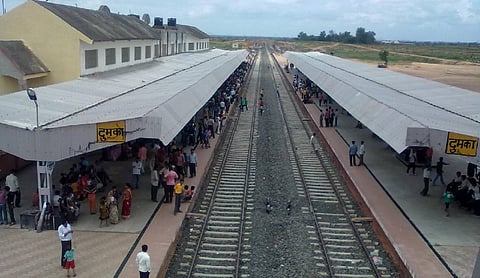

Dumka, Jharkhand’s second capital and an important administrative centre in Santhal Pargana, continues to lag behind neighbouring Godda in long-distance railway connectivity, despite having entered the railway network more than a decade before its neighbour.
The contrast is striking. Godda, which received its first train in April 2021, has rapidly secured express services connecting it to major cities, including New Delhi, Mumbai, Kolkata, Lucknow, Ranchi and Jamshedpur. Dumka, by comparison, remains heavily dependent on passenger trains and a limited number of long-distance services, forcing many residents to travel to other stations for convenient connections to major destinations.
Dumka’s railway ambitions date back to around 2004, when the Jasidih-Dumka-Rampurhat railway link was sanctioned under the Atal Bihari Vajpayee government. However, land acquisition difficulties, administrative delays and geographical challenges prolonged construction. The first commercial passenger train from Jasidih reached Dumka in July 2011. Extensions towards Rampurhat in West Bengal and Hansdiha followed over the next five years, giving the town connections in three directions.
Despite this expansion, Dumka failed to emerge as a major long-distance railway terminal. Its express services remain limited, including the Ranchi Intercity Express, Mayurakshi Express to Howrah and a connection to Patna, alongside a few weekly trains. Daily passenger and MEMU services cater largely to commuters, traders and pilgrims travelling to Basukinath.
Godda’s railway development, meanwhile, gathered pace soon after its first train arrived. The town now originates around seven to eight pairs of long-distance express services, including trains connecting it with New Delhi and Mumbai. Its relatively limited commuter services are supplemented by direct links to major urban centres.
Political lobbying has played a significant role in shaping this difference. Godda MP Nishikant Dubey has actively pursued railway projects, infrastructure development and new train services for his constituency. Dumka, in contrast, has not witnessed a comparable push to establish itself as a major originating station. This difference in political prioritisation has contributed to the growing gap in connectivity.
The 38-km Hansdiha–Mohanpur railway link has further altered the region’s connectivity patterns. By connecting Hansdiha directly with Mohanpur and Deoghar, the route allows trains to reach the Jasidih–Deoghar corridor without passing through Dumka. Consequently, some long-distance services can bypass the town, limiting its prospects of attracting additional train operations.
Infrastructure constraints have also hindered Dumka’s growth as a terminal. The station lacks key facilities such as pit lines, comprehensive coaching maintenance infrastructure and automated washing facilities required to support the regular origination of more long-distance trains. Railway jurisdictional divisions across the routes towards Jasidih, Rampurhat and Mandar Hill have also complicated coordinated planning.
The result is a connectivity gap that affects passengers, traders and businesses across the region. Residents seeking overnight journeys to New Delhi, Mumbai and western India often have to travel to Jasidih or Godda to access suitable trains.
For Dumka, the challenge is no longer merely securing railway access but converting its administrative importance into better passenger connectivity. Expanding terminal infrastructure, improving coordination among railway divisions and introducing more long-distance services could help address the disparity with Godda.