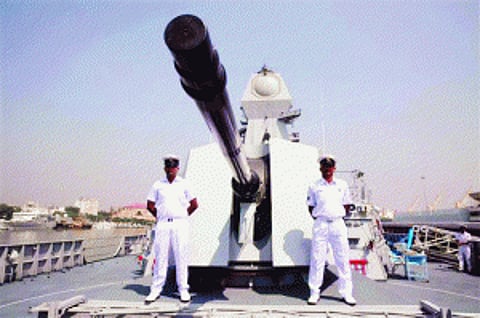

Ship ‘Kochi’, the second ship of the Kolkata-class (Project 15A) Guided Missile Destroyers, will be commissioned into the Indian Navy by Defence Minister Manohar Parrikar, at Naval Dockyard here on Wednesday.
INS Kochi is packed with an array of state-of-the-art weapons and sensors, with a significant indigenous component. The ship thus has many lethal weapons to her credit which include the successful fitment of vertically launched missile system for long distance engagement of shore and sea based targets. The ship is one of the few warships of the world and the second in the Indian Navy to have Multi-Function Surveillance and Threat Alert Radar to provide target data to long Range Surface to Air Missile system. The MF STAR and lR SAM systems are jointly developed by Defence Research and Development Organisation (DRDO) and Israel Aerospace Industries ltd. To protect against incoming air borne and surface threats, at medium and close in range, the ship has 76 mm and 30 mm gun mounts.
The ship is equipped to store and operate two helicopters (Seaking 42B or Chetak). In consonance with the national vision of achieving maritime security through self-reliance, the ships have significantly higher level of indigenisation as compared to the Delhi class. Designed by the Indian Navy’s in-house organisation, Directorate of Naval Design, and constructed by Mazagon Dock Shipbuilders ltd, Mumbai the ship is christened after the vibrant port city of Kochi.
Though conceived as follow-on of the earlier Delhi Class, this ship is vastly superior and has major advancements in weapons and sensors. The ship incorporates new design concepts for improved survivability, stealth, sea-keeping, and manoeuvrability.
With a displacement of 7,500 tonnes, the majestic ship spanning 164 meters in length and 17 meters at the beam, is propelled by four gas turbines and designed to achieve speeds in excess of 30 knots. The ship has a complement of about 40 Officers and 350 Sailors. The accommodation and living spaces have been designed with special emphasis on ergonomics and habitability.
Enhanced stealth features have been achieved through shaping of hull and use of radar-transparent deck fittings. A bow mounted Sonar Dome, the second of its kind in an indigenous naval platform, has been introduced to enhance sonar acoustic performance.
The ship can truly be classified as a ‘Network of Networks’ as it is equipped with Ship Data Network (SDN), Combat Management System (CMS), Automatic Power Management System (APMS) and Auxiliary Control System (ACS). The SDN is the information highway on which data from all the sensors and weapons ride. The CMS performs threat evaluation and resource allocation based on the tactical picture compiled and ammunition available onboard. While propulsion and power management is done using the APMS, remote control and monitoring of machinery is achieved through the ACS.
Some of the major equipment/systems developed indigenously and fitted onboard include; Ship’s Data Network ( Messrs BEl, Bangalore), Combat Management System (BEl, Ghaziabad), Bow Mounted Sonar (BEl, Bangalore), Electronic Warfare Suite (BEl, Hyderabad), Close-in weapon System (Gun Shell Factory and BEl, Chennai), Indigenous Rocket launcher ( Messrs l&T), Indigenous Torpedo Tube launcher for ASW (l&T) Boat Davits (l&T) and Automated Power Management System (l&T).
In a related development, three Immediate Support Vessels (ISVs) will be commissioned into the Indian Navy in presence of Vice Adm SPS Cheema, the Flag Officer Commanding-in-Chief Western Naval Command as T-48, T-49 and T-50 on Tuesday.
With the induction of three new ISVs, the total number of such vessels in the Indian Navy will go up to 23 - of which will be based in Mumbai.
In keeping with the Prime Minister’s call to ‘Make in India’, 14 of the ISVs were built indigenously by M/s SHM Shipcare, Thane while four were built by Messrs ADSB and five by Messrs Rodman Polyships.
These vessels will provide protection to the Offshore Development Area, Bombay High oil platforms as they are commonly known as, which accounts for approximately 7o per cent of the indigenous hydrocarbon production in the country. Built to international standards, by adopting state of art material and production technologies, these ships, armed with Heavy Machine Guns (HMGs) and propelled by Water Jet propulsion, can operate at maximum speeds of 40 Knots, economical speeds of 20 Knots with an endurance at sea of 500 nautical miles.