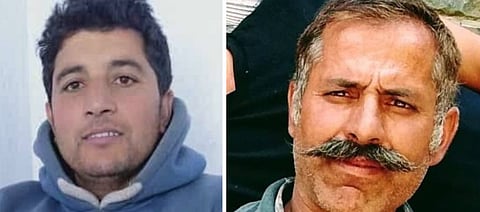


Srinagar: The killing of two Special Police Officers (SPOs) in Jammu and Kashmir's Kishtwar district has triggered a political controversy, with the Congress and the BJP raising questions over the circumstances of their deaths and demanding an investigation.
Jammu and Kashmir Congress president Tariq Hamid Karra alleged that the two SPOs were returning from a hunting trip in civilian clothes when Army personnel mistook them for militants and opened fire. He said the allegation was based on information received from party workers in the district and called for a thorough probe.
"My district president there has informed that the two SPOs had crossed two check points while going for hunting but while returning, Army mistook them as militants as they were in civvies and opened fire," Karra said.
He also questioned BJP MLA Shagun Parihar's claim that mosque loudspeakers had been used to issue instructions to kill Hindus before the two SPOs were killed.
"The BJP says militants killed them. Only a probe can establish the facts," Karra said, alleging that the BJP was attempting to communalise the matter. He demanded that Parihar's claim also be investigated and said she should resign if it was found to be false.
The bullet-riddled bodies of the two SPOs, identified as Babi Chand (57) and Rashpal Kumar (45), were recovered from Kishtwar on November 12, a day after they went missing from the remote Dachhan area.
Both officers were attached to the Special Operations Group (SOG) of the local police and posted at Kiyar village in Dachhan. They went missing on November 11 while travelling from their camp to an Army post at Dharna-Marwah.
The BJP also questioned the circumstances in which the two personnel were deployed in the area. Sunil Sharma, Leader of the Opposition in the Jammu and Kashmir Assembly, visited the bereaved families along with BJP MLA Shagun Parihar and raised concerns over their deployment in what he described as dangerous territory.
"Why were they asked to cross a dangerous forested area and join a camp in another jurisdiction with just an INSAS and 303 rifle? This raises questions over the senior police officials," Sharma said.
He also alleged that some police officials had engaged overground workers of terrorists as SPOs. Sharma also questioned the manner in which the bodies were transported, asking why they were brought in a dumper and why the local Senior Superintendent of Police (SSP) had not visited the families even after two days.
Sharma said he had raised the concerns with Jammu Inspector General of Police Tejinder Singh and Deputy Inspector General of Police, Doda-Kishtwar-Ramban range, Sargun Shukla, who were present at the spot.
"We will talk to LG and provide him all the details and ensure that such officers are not posted here," Sharma said, adding that the circumstances surrounding the killings should be thoroughly investigated. He also questioned why the SOG camp had been shifted from the area and said people in the region had made significant sacrifices over the past three decades.
Meanwhile, BJP legislator R S Pathania criticised Karra's remarks and demanded an apology from the Congress.
"At this sensitive juncture, the J&K Congress president has chosen to float an unsubstantiated theory, create confusion and cast aspersions on our security forces without waiting for the investigation to establish the facts," Pathania said.
He added that the sacrifice of the two personnel should not be used for political point-scoring and urged the Congress to withdraw its remarks and apologise to the bereaved families, security forces and the nation.
(with inputs from media organisations)