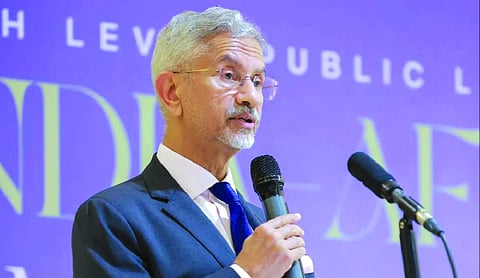

India and the United States are continuing negotiations to resolve outstanding differences over a proposed bilateral trade agreement, with talks moving toward a possible “landing point,” External Affairs Minister S Jaishankar said ahead of US Secretary of State Marco Rubio’s anticipated visit to India.
Speaking at the Bloomberg New Economy Forum on Tuesday evening, Jaishankar said negotiations were progressing but declined to disclose details of the discussions.
“I think we are waiting on a few things. I wouldn’t be comfortable spilling the beans in public,” he said when asked about the status of the proposed trade deal. Jaishankar said India’s Commerce and Industry Minister, the US Trade Representative (USTR), and other officials were discussing how to resolve the remaining differences and move the agreement forward.
“I sense that this is an issue which is heading towards a landing point,” he said.
India and the US have been negotiating a bilateral trade agreement since early 2025, seeking to address tariff-related tensions, reduce non-tariff barriers and expand market access. New Delhi seeks more favourable tariff terms for Indian exports than those offered by competing economies.
Jaishankar noted that the outcome would depend not only on the terms India and the US negotiate but also on the agreements Washington reaches with other competing economies. Earlier this month, US Trade Representative Jamieson Greer said the two countries were working to finalise a bilateral trade agreement, though a deal was not imminent. He said both sides had identified the outstanding issues and were working to resolve them.
Jaishankar’s remarks came more than a week after Finance Minister Nirmala Sitharaman said negotiations on the trade deal had reached a “plateau”. The external affairs minister also discussed Washington’s changing approach to global economic engagement, saying the US was seeking to rebuild its manufacturing base and reset the terms of access to its domestic market.
“The US is today determined to re-industrialise and to reset the terms of access to its economy,” he said, adding that tariffs were closely linked to these objectives. He noted that major economies around the world were negotiating with Washington in response to its evolving trade policy.
“We’re not alone in this. In our case, we are pretty far advanced in that process of negotiation,” Jaishankar said.
On the broader bilateral relationship, Jaishankar said the US was reassessing the terms of its alliances and treaty relationships, with the impact being felt particularly in Europe and, to some extent, East Asia. However, he distinguished India’s relationship with Washington from formal military alliances, describing the two countries as strategic partners. “We have many issues we are working on with the United States, but we don’t have an issue of the terms of alliance because we are not officially an ally,” he said.
“India is a country which has a strong strategic partnership with the US, but a strategic partnership is a partnership; it’s not an alliance,” he added. Jaishankar said India and the US have spent more than two decades identifying areas of convergence, shared interests, and common priorities, and that the fundamental basis of their relationship has not changed.
India-US relations have faced significant strain after Washington imposed punitive tariffs on Indian goods last year. Tensions were also heightened by US President Donald Trump’s claims about his role in de-escalating the India-Pakistan military confrontation in May 2025, which drew sharp reactions from Indian officials.
Disputes over US immigration policy and the decision to raise H-1B visa fees have further strained bilateral ties. Washington’s move to restrict a key green-card processing programme affecting major global technology companies, including Indian IT firms Tata Consultancy Services and Wipro, has added to the concerns.
Against this backdrop, the proposed trade agreement remains a key test of the two countries’ ability to manage economic differences while preserving their broader strategic partnership. Jaishankar’s latest remarks suggest that, despite unresolved issues, both sides continue working toward an agreement.