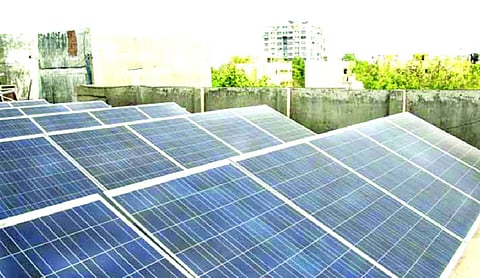

More than one lakh power consumers in the capital have registered for rooftop solar connections within a month of a dedicated portal being launched. Latest figures up to October 21 show 1,02,461 registrations. The drive is part of the Delhi government's plan to provide 2,30,000 free installations by March 2027.
Power Minister Ashish Sood called the numbers a milestone in clean energy. He said the achievement belongs to the citizens of Delhi. "Our people are stepping forward to make Delhi cleaner, greener, and energy independent," he said. He also said the progress was inspired by Prime Minister Narendra Modi's leadership and PM Surya Ghar initiative.
The numbers show that people across the city are signing up. BSES Rajdhani Power Limited (BRPL) leads with 37,168 registrations. These come from South and West Delhi. BSES Yamuna Power Limited (BYPL) has 32,718 registrations from East and Central Delhi. Tata Power Delhi Distribution Limited (TPDDL) has 32,575 registrations from North and North West Delhi. Officials said the response has not been the same everywhere. City outskirts and industrial hubs such as Bawana and Narela lead in registrations. These areas often have larger rooftops and open spaces, which suit high-capacity installations, officials noted. Planned residential colonies in West, North and Northwest Delhi have also shown a strong response.
Apartment residents have an option too. Group net-metering policies allow multi-storey apartments to share the benefits of solar power. Sood urged Resident Welfare Associations (RWAs) and group housing societies to make use of the group net-metering schemes so that apartment residents can share solar power easily.
For households, the cost of installation is a key concern. The scheme was announced last month by Chief Minister Rekha Gupta. It covers 2,30,000 free rooftop solar power plants of 3 KW capacity each in the first phase of the Pradhan Mantri Surya Ghar: Muft Bijli Yojana. A portal was also launched for eligible power consumers to register. Under the scheme, the Central government gives a subsidy of
`78,000. The Delhi government will extend a subsidy of `30,000. This will be raised further to `78,000 with a one-time, advance payment of a generation-based incentive.
Officials said adoption is also being driven by combined central and state subsidies, timely disbursal of incentives and efficient net-metering approvals. Sood said the government is working to streamline net-metering approvals, simplify digital processing and ensure fast disbursal of subsidies directly to consumers. He said this is being done under the updated Delhi Solar Energy Policy framework, which combines state and central incentives to lower installation costs for families. The minister said the government wants every citizen to be able to access the benefits of solar energy easily. "Our government is committed to ensuring that every citizen, whether living in an apartment, a plotted colony, or an informal settlement, can access the benefits of solar energy easily," he said.
Ashish Sood also appealed to house owners, businesses, and community leaders to join the effort. He said installing rooftop solar panels is not only about saving on monthly electricity bills. It also helps reduce carbon emissions and gives future generations cleaner air.