
Amid growing opposition to the Great Nicobar Island Development Project, which “threatens to cause ecological harm and displace tribal communities”, Union Home and Cooperation Minister Amit Shah said on Monday that the project would enhance India’s maritime global trade.
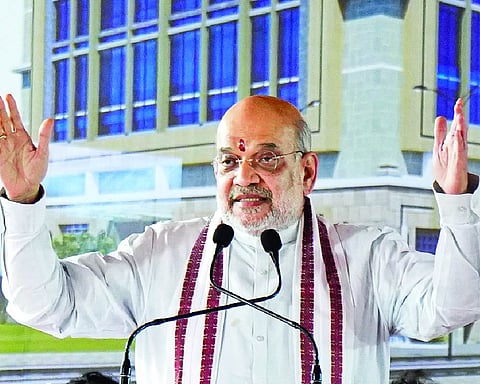
Speaking at a function after inaugurating ‘India Maritime Week — 2025’, Shah said that Prime Minister Narendra Modi’s maritime policy had evolved into MAHASAGAR (Mutual and Holistic Advancement for Security and Growth Across Regions), “which has become a symbol of India’s growing global footprint”.
Shah said that Prime Minister Modi’s vision of transforming “Sagar” into “Mahasagar” would propel India toward becoming a global leader in this sector by 2047. “To achieve this, the Modi Government has increased the budget six-fold, raising it from 40 million dollars to 230 million dollars today,” he said.
Shah said that under the Sagarmala project, 839 projects worth 70 billion dollars had been identified for completion by March 2025, of which 272 projects worth 17 billion dollars have already been completed.
“The 5-billion-dollar Great Nicobar Project is under construction, which will significantly enhance India’s maritime global trade,” the Union Home Minister said.
Shah said that additionally, with an investment of 200 million dollars, the Modi-led NDA Government was forging ahead in the construction of India’s largest dock at Cochin Shipyard.
“A Maritime Heritage Complex is being developed in Gujarat. To align with essential international laws, outdated Indian laws have also been reformed. In 2025, our Parliament passed the 117-year-old Indian Ports Bill, updated to reflect contemporary needs and a global perspective,” he said.
“Through the Major Port Authorities Act, 2021, we have paved the way for granting greater autonomy to ports and modernising their institutional framework. He also mentioned that 106 new waterways have been declared under the National Waterways Act, 2016,” Shah said.
Shah said that the Modi government has ensured the development of the Blue Economy to enhance security, coastal security, and the safety of fishermen.
“Over the past decade, coastal shipping has seen a 118 per cent increase, and cargo handling has risen by 150 per cent. We have reduced Turn-Around-Time (TAT), bringing it closer to global standards. To promote a circular economy in the maritime sector and advance shipbuilding, policy decisions have been made,” Shah said.
“India’s goal is to build a Green Maritime Future that accelerates development while maintaining balance with nature. India does not forget that Small Island States and many countries in the Global South depend on the sea for their livelihood and survival. For these nations, climate change is an existential issue, and India is moving forward with a vision to create a green, prosperous, and shared ocean, keeping this in mind,” Shah added.
Maharashtra Chief Minister Devendra Fadnavis, his counterparts from Gujarat, Goa, and Odisha, Bhupendra Patel, Dr. Pramod Sawant, Mohan Charan Majhi respectively, Maharashtra Deputy Chief Ministers Eknath Shinde, Ajit Pawar, and Union Minister for Ports, Shipping, and Waterways Sarbananda Sonowal were prominent among those present at the function.
Shah’s affirmation that the Government is going ahead with the Great Nicobar Island Development Project should be seen in the context of growing opposition to the project from the scientists, environmentalists and also the Opposition Congress.
A group of scientists, environmentalists, and former bureaucrats has urged the Government to reconsider going ahead with the project on the ground that it was an “exploitative commercial endeavour disguised as a strategic defense initiative” and that it “threatens massive ecological and social harm, displacing indigenous communities and devastating pristine forests”.
The 5-billion-dollar Great Nicobar Project involves the construction of a transshipment port, an international airport, a township, and a power plant. The opposing group has alleged that the project would “endanger over 130 square kilometers of pristine forest, affecting indigenous Nicobarese and Shompens tribes and its ecological and social impact could be irreversible.
On his part, senior Congress leader and former Minister of State for Environment and Forests Jairam Ramesh had recently alleged that the Government had not addressed the “core concerns” raised on the project, which will “no doubt displace tribal communities” and bring widespread ecological damage to the area.
“The environmental impact assessment conducted was rushed, incomplete, and flawed. The fact that further impact studies have been mandated after the project has been granted clearance shows up its limitations. It is surprising that the assessment began even before terms of reference for it were issued,” Ramesh wrote in a post on X.
Debunking the Government’s idea of compensatory afforestation, Ramesh said that the idea amounted to a “bogus equivalence” that planting trees in Haryana would compensate for tree felling in the Great Nicobar.
“Ecologically, planting trees in Haryana (which needs to be done anyway) will just not compensate for the clear-felling of multi-species, biodiversity-rich forests in the Great Nicobar Island. It is really a bogus equivalence,” the Rajya Sabha member said.
The Congress leader said that “Scientists in public institutions themselves have spoken about being asked to provide reports favourable to the project, some even having to resign due to pressure to provide a clean chit to the project”.