
In a major milestone, the forest rights framework is acting as a catalyst for tribal development in Chhattisgarh, where the state has so far distributed 4,88,079 individual forest rights titles, 46,868 community forest rights titles and 4,412 community forest resource rights titles.
Official sources describe Chhattisgarh as the country’s leader in the recognition of the Forest Rights Act, which provides for individual and community ownership over forest resources.
The implementation of the Act is clearly visible in hamlets like Bedre, under Silger gram panchayat in formerly Naxal-affected Sukma district. Bogam Bhima, a Muria tribal farmer, has long ploughed and sown a plot of forest land there without any legal right to it. He now holds a title for 1.315 hectares, and he can raise paddy on the land without fear or uncertainty.
The clear title also brought another welcome change. A pucca house has been sanctioned in his wife’s name under the Pradhan Mantri Awas Yojana. Displaying his gratitude to the state Government, Bhima has said the family now has respect, security and fresh hope for the future.
The three years of the Vishnu Deo Sai Government offer a glimpse of how impactful these rights have been on tribal communities. About 12,531 individual titles covering over 11,390.993 hectares, 192 community titles covering 2,495.77 hectares and 105 community forest resource titles covering 13,607.443 hectares have been issued. The total figure stands at 12,828 titles covering over 27,000 hectares of forest land. The 105 community forest resource titles alone cover more than all the individual titles combined, which is a clear pointer to how much of the recent recognition has gone to village communities as a whole. Recognition on paper has also been followed by changes in procedure. A decision taken by the state Government now allows the forest land held by a deceased title-holder to be mutated in the names of his or her heirs through a simplified process.
Officials say this is the first time the state has made such a provision, and that mutation is being carried out within the prescribed time limits. So far, 16,105 applications relating to mutation, demarcation, partition, correction of errors and appeals have been disposed of. This has removed the difficulty families faced in passing forest land from one generation to the next.
In Mahasamund district, community rights have taken a different form. So far, about seventy-three gram sabhas have received certificates recognising their community forest resource rights, which places the protection and management of the forest in the hands of the villages. Four of them, Bakma, Bhalukona, Dwartara Kala and Dwartara Khurd, have been awarded a special scheme under which Rs 50,000 each has been given for forest conservation and livelihood work.
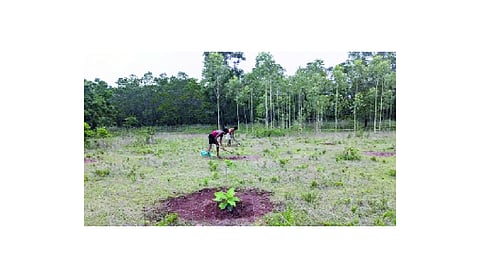
The funds are being used for planting fruit-bearing and medicinal trees, soil conservation, protecting biodiversity and keeping fires out of the forest. Guided by the experience of elders, the whole village took part in maintaining the forest. “Earlier we only took from the forest; now we are giving back to it. This forest is ours, and we are its guardians,” says Sunil Kumar Sahu of Bakma village.
As saplings, including amla, mango, jamun, drumstick and medicinal plants planted by the villagers mature, they are expected to improve nutrition in village households and give families surplus produce to sell in the market. The medicinal plants are also expected to make traditional forest medicines more readily available locally and create a viable source of livelihood.
