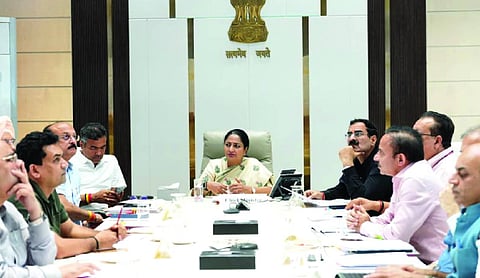

The Delhi Government has approved a new industrial policy for the next 10 years, focusing on tailored incentives for 10 priority sectors, including IT and IETS, global capability centres, data centres, and healthcare, to make the national Capital a technologically driven, clean industrial hub.
The Industrial Policy, 2026, approved in a Cabinet meeting chaired by Chief Minister Rekha Gupta on Tuesday, also allocated `1,000 crore under Mukhyamantri Udyamshree Yojana for five years to promote new industries and create jobs, said a statement from the Delhi Chief Minister’s Office.
A dedicated Government agency, ‘Invest Delhi’, will promote investment over the 10-year policy period, serving as a single point of contact and guiding investors from initial information and site selection to securing approvals, disbursing incentives, and resolving grievances.
Invest Delhi will operate through the Delhi Udyog Mitra portal designed to make approval processes faster, simpler and more transparent, the statement said.
A salient feature of the policy is higher incentives offered to women entrepreneurs and employees, with a focus on the MSME sector.
Among the top-ten priority sectors, entrepreneurs under the Information Technology (IT), IT Enabled Services (ITES) and digital services will receive a 25 per cent incentive on digital infrastructure investment, up to `10 crore for three years. The incentive will be up to `12 crore for women entrepreneurs.
Besides, office rental assistance of 40 per cent, up to
Rs 2 crore, will also be provided for three years. Bandwidth and cloud services will qualify for 25 per cent assistance for two years, capped at `10 lakh annually, according to the statement. Incentives of Rs 40,000 to Rs 50,000 will be provided for each new hire.
Incentives up to `50 crore (up to `60 crore for women) will be given on digital infrastructure investment for global capacity centres in the first five years. Office rental assistance of 40 per cent, capped at `2 crore, will be provided for two years, while each new hire will qualify for an incentive of Rs 1 lakh to Rs 1.2 lakh.
The policy also provides 50 per cent assistance for certification, up to `25 lakh; a 30 per cent incentive for research and development, up to `5 crore; and 25 per cent assistance for units developing workspaces, up to `10 crore.
Investment incentives for data centres, research and development and testing facility, healthcare and wellness services and urban logistics will be up to `10 crore (`12 crore for women). Other sector-specific incentives such as assistance for low water consuming cooling systems, certification and data security related expenses, patent related assistance will also be available.
Research and development and testing facilities will receive `5 lakh per patent, for a maximum of four patents, besides getting up to `25 lakh for laboratory accreditation-related expenses. Healthcare investments will get `50,000 to `60,000 for hiring each new specialist doctor. New warehousing units will receive up to `10 crore (`12 crore for women), while existing units will be eligible for assistance capped at `1 crore. Cold-chain facilities will qualify for incentives up to Rs 2 crore.
Technology adoption in logistics will receive incentives capped at `50 lakh, while the use of green energy will qualify for incentives up to
`2 crore. Circular economy and waste management, precision manufacturing, industry-linked skill development and technology modernisation of MSMEs will also be covered by various kinds of incentives.
The new policy seeks to position Delhi as a leading hub for advanced technology, Global Capability Centres (GCCs), data centres, research and development, healthcare services, urban logistics, and precision manufacturing by attracting fresh investments, the chief minister said.
Keeping the needs of different sectors in mind, tailored incentives would be provided for capital investment, office or workspace rentals, new hiring, research, certification, technological modernisation, energy conservation and skill development. The policy will also encourage resource reuse and waste reduction, she added.