
For Jammu and Kashmir, geography has always come with a cost. Mountains that make the region spectacular have also made movement difficult, winters isolating and access to markets expensive. For decades, improving connectivity remained one of J&K’s biggest development challenges.
That is beginning to change. The Narendra Modi Government has made infrastructure a central part of its approach to Jammu and Kashmir, investing heavily in railways, highways, tunnels, airports and logistics. What is taking shape is not simply a collection of big-ticket projects, but a wider attempt to reduce the economic distance between the region and the rest of the country.
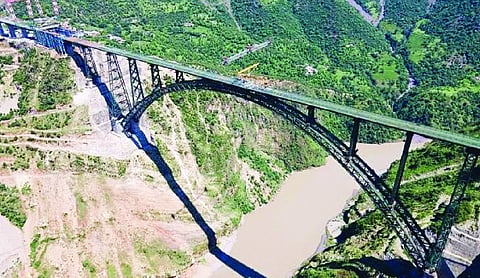
Nothing illustrates this better than the Udhampur-Srinagar-Baramulla Rail Link (USBRL). Inaugurated in June 2025, the Rs 43,780-crore project finally connected the Kashmir Valley with the national railway network. Building 272 km of railway through the Himalayas required 36 tunnels stretching around 119 km and 943 bridges. Its centrepiece is the Chenab Rail Bridge in Reasi.
These are impressive engineering statistics, but their importance lies beyond record books. Vande Bharat trains began operating between Katra and Srinagar in June 2025 and were extended to Jammu Tawi in April 2026. Jammu to Srinagar can now be covered in less than five hours. Snow-removal trains and systems designed for extreme weather are intended to keep services running even when winter conditions turn difficult. A similar effort is visible on the roads. The 6.4-km Sonamarg, or Z-Morh, Tunnel has given the popular destination all-weather connectivity. The 13.15-km Zojila Tunnel, once completed, will strengthen year-round access towards Ladakh and is expected to reduce the Sonamarg-Minamarg journey from roughly two hours to about 30 minutes.
Meanwhile, new rural roads and highways are pushing connectivity further into districts. In August 2026, foundation stones were laid for 110 PMGSY-IV road projects covering nearly 600 km across Udhampur, Kathua, Doda and Kishtwar. The push is extending to aviation as well. A Rs 1,677-crore expansion of Srinagar International Airport was approved this year, with a new terminal designed to handle up to 10 million passengers annually. Udhampur and Kishtwar are also planned for regional air connectivity under UDAN. The next challenge is to turn this infrastructure into economic opportunity. A Gati Shakti Cargo Terminal is already operational at Samba, with others proposed in Kathua, Anantnag and Jammu. Faster and more reliable transport can give apples, dry fruits and other local products wider markets while helping tourism move beyond its traditional seasonal and geographical limits. For years, it was told that connectivity in Kashmir was impossible due to treacherous mountains. But the Modi Government’s infrastructure push has changed this perception. Now people of J&K say —Where there is a will, there is a way.
The real measure of success, however, will not be the number of bridges built or tunnels bored. It will be whether a farmer gets produce to market faster, a tourist stays longer, a young person finds work closer to home. J&K’s infrastructure story will ultimately be judged not by engineering records made, but by how they brought tangible changes in the lives of the people.