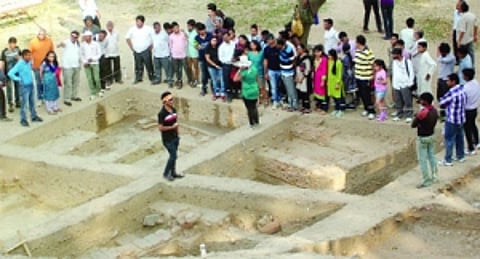

It was a travel 2,000 years back in time for Delhiites as they witnessed the city’s first ever exhibition of ancient artifacts unearthed from the Purana Qila. The oldest fort of the Capital witnessed one of the highest footfalls on Friday as scores of history enthusiasts thronged the place to get the feel of various dynasties that lived and perished on the same soil.
From broken pieces of jewellery to stone sculptures of different gods, the exhibition had an array of relics on display. It being held on World Heritage Day, everyone was allowed free entry to the fort resulting in an overwhelming turnout. “It is a great pleasure to see so many people taking interest in history. So far, over 5,000 visitors have come and the good part is that people are asking questions. This means that they just don’t want to see but want to learn as well. It is very encouraging,” said Vasant K Swarnkar, chief, ASI (Delhi circle).
“Something like this happening in the city has come after a long time. My mother used to bring me here (Old Fort) when I was a child. That time also there was an excavation going on where it was found that the fort once housed the legendary city of Indraprastha. It feels nice to see another excavation here, I can comprehend things much better now,” said Rama Goel, 55, who wheeled her 81-year-old mother, Mithilesh, to show the ancient findings.
For 17-year-old Aditi Gupta, the excavations carried out by the Archaeological Survey of India (ASI) hold a lot of importance. “I have history as my subject and I will pursue the subject further in my graduation. I can relate the pottery items, jewellery, sculptures and other daily use items that are on display with what we have been taught at school,” said Aditi, a student of Delhi Public School, Mathura Road.
Young historians were present at the excavation site to guide visitors and answer to their numerous queries. The site took people back 2,000 years behind to the Kushan dynasty and then the Gupta period. The project at Purana Qila began in January this year. The artifacts on display included a rare 12th century sculpture of Vishnu, a seal in terracotta from the Gupta period, pottery typical of the Kushan and Gupta periods, structures from the Rajput and Kushan periods, copper coins that are yet to be deciphered, terracotta human figurines, microbeads made of semi-precious stones and glass, ear studs of terracotta and, charred wheat and rice grains. Women were delighted to see ivory pendant, human figurines, a Gajalakshmi tablet and structures from the Mauryan period as well.
“It is for the first time that findings of an excavation are at display in Delhi. The findings of the excavation carried out here 40 years ago were not shown to the public. We are planning to extend our site further to find out more. So far we have not found trace of the Indraprastha city,” added Swarnkar.