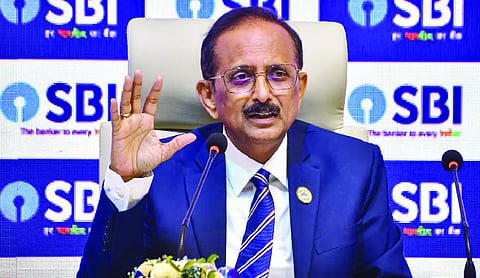

SBI chairman CS Setty on Thursday warned that AI should not exclude rural borrowers, small businesses and new-to-credit borrowers from getting loans due to biases in a design system.
Speaking at an event organised by Excellence Enablers, Setty said financial inclusion should remain the central focus of the design and deployment of AI tools and underscored that it is the responsibility of bank boards to make sure that systems are deployed with the right architecture.
“Boards must ensure that technology doesn’t inadvertently exclude rural borrowers, small borrowers or individuals without conventional credit histories. Financial inclusion must remain central to the design and deployment of AI because innovation must ultimately widen opportunity rather than narrow it,” he said. This is essential to have in mind given the diversity of a vast country like India, he said. The board must ensure that AI adoption is driven by institutional purpose rather than technological momentum, the chairman of the largest Indian lender said.
He also said that given the greater thrust on bank boards, it is important to include the basics of AI in the yearly training on cybersecurity given to such directors. SEBI chairman Tuhin Kanta Pandey said the capital markets regulator is exploring a ‘capacity building network’ for independent directors to equip them to deal better with issues such as cybersecurity, AI and data governance.
Setty said AI has great power to improve efficiencies and deliver productivity gains, and listed how SBI itself has been using AI for many years, including in cheque clearing and giving personal loans.
“The fairness piece is very important for SBI. We talk about model biases, which are critical concepts for us. When you are looking at a highly diversified customer base, this fairness and preventing biases is extremely important from a governance point of view,” he said.
Setty said errors in AI systems may extract a very high cost.
“Errors may no longer remain confined to a single process but could cascade across interconnected systems, which we are witnessing across the globe today, making clearly defined permissions, transaction limits, audit trails and intervention mechanisms extremely important,” he said.
