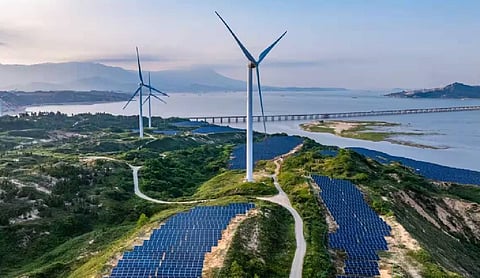

Adani Green Energy Ltd (AGEL) reported a 41% year-on-year increase in earnings before interest, taxes, depreciation and amortisation (EBITDA) from power supply to Rs 7,957 crore in the first half of the current financial year, driven by capacity expansion and higher electricity sales.
The company’s energy sales rose 32% to 25,747 million units (MUs) during April-September 2026, while revenue from power supply increased 36% to Rs 8,299 crore. Cash profit grew 35% year-on-year to Rs 4,176 crore in the first half of FY27, according to the company’s financial results announced on Wednesday.
The performance was equally strong in the July-September quarter. EBITDA from power supply surged 51% year-on-year to Rs 3,835 crore, while revenue increased 45% to Rs 4,019 crore. Energy sales grew 33% to 12,090 MUs, and cash profit rose 45% to Rs 1,951 crore.
AGEL’s operational renewable energy portfolio expanded 24% year-on-year to 20.8 GW in the first half, supported by the addition of 4,083 MW of capacity. The additions included 2,957 MW of solar power, 805 MW of wind power and 321 MW of solar-wind hybrid capacity, strengthening the company’s position in India’s renewable energy sector.
Battery energy storage emerged as another major growth area. The company added 3,081 MWh of battery energy storage system (BESS) capacity at Khavda in Gujarat during the second quarter, taking its cumulative operational storage capacity to 6,632 MWh, or 6.63 GWh. According to AGEL, this accounts for more than half of India’s operational battery storage capacity and represents the world’s largest single-location battery storage deployment.
The company indicated that it could exceed its target of 10 GWh of operational battery storage capacity in FY27, supported by the pace of installations so far.
Ashish Khanna, CEO of AGEL, said the company’s strong execution during the first half reflected the expansion of its renewable energy portfolio and improved performance across solar, wind and hybrid assets. He also highlighted the importance of battery storage in managing fluctuations in renewable power generation, while noting that the availability of transmission infrastructure remained an important consideration.
AGEL invested Rs 17,160 crore in capital expenditure during the first half, an increase of 38% year-on-year, as it continued to expand its generation and storage infrastructure. Its net debt-to-run-rate EBITDA ratio stood at 5.6 times.
At Khavda, the company’s renewable energy project in Gujarat, operational capacity has increased to around 10.8 GW from 7.1 GW a year earlier. The company is developing a 30-GW renewable energy plant across 538 square kilometres and aims to achieve the targeted capacity by 2029. The project uses technologies such as robotic solar module installation to accelerate construction.
AGEL is targeting an operational renewable energy portfolio of 50 GW by 2030. The company also reported continued recognition for its environmental, social and governance performance, including top rankings in several sustainability assessments and awards for its Khavda battery storage project.