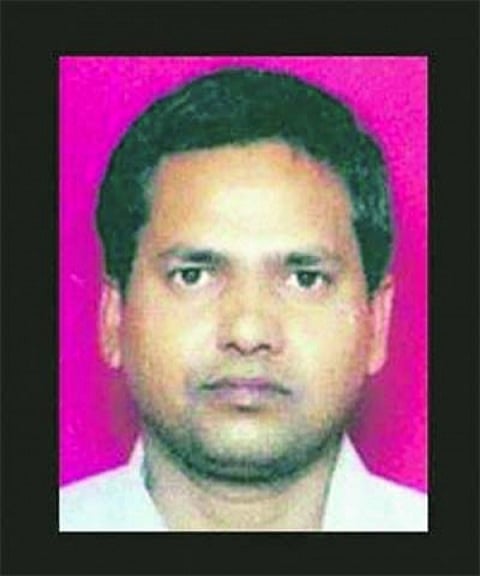

In the first such fake encounter case where the largest-ever number of offenders were brought to justice, a city court on Friday sentenced as many as 21 convicts, including 13 policemen, to life imprisonment for killing fugitive gangster Ramnarayan Gupta alias lakhan Bhaiyya in “cold blood” in November, 2006.
A week after encounter-specialist Pradeep Sharma was acquitted in the same case for lack of evidence, the city court handed life terms to convicted senior Inspector Pradeep Suryavanshi -- who had led the team that eliminated lakhan Bhaiyya, an aide of underworld don Chhota Rajan -- and two police officers Tanaji Desai and Dilip Palande for murder.
Ten other policemen were sentenced to life imprisonment for aiding and abetting the murder of lakhan Bhaiyya, while eight other civilians were also sentenced to life for playing a role in the fake encounter. lakhan Bhaiyya was shot dead in an encounter near Nana Nani Park at Versova in north-west Mumbai, on November 11, 2006.
On that day, a police team — led by Suryavanshi — had picked up lakhan Bhaiyya from his Navi Mumbai residence, and gunned him down in a “fake” encounter the same evening.
After the encounter, the police had, however, claimed that acting on a tip-off that lakhan Bhaiyya, a close aide of Rajan’s lieutenant DK Rao, would come to meet a “contact” at Nana-Nani Park in Versova, they had laid a trap for him.
lakhan Bhaiyya, against whom 19 cases - including murder, dacoity and extortion - had been registered, had not only refused to surrender, but had also fired at the police party, prompting the encounter specialists to eliminate him in the purported encounter, the police had claimed further then.
The court had on Friday last acquitted Pradeep Sharma, the accused number one, after the Prosecution failed to prove that he was physically present at the Nana Nani Park, the encounter site, at the time of the incident. This was despite the “evidence” that the Prosecution had produced against Sharma in the form of a ballistic report which concluded that one of the five bullets fired at lakhan Bhaiyya came from his (Sharma’s) service revolver.
Though the Prosecution had claimed that Sharma had taken supari (contract) to eliminate lakhan Bhaiyya from a Navi Mumbai Janardhan Bhange, the court did not find adequate evidence to convict the controversial encounter-specialist (Sharma) who had shot to fame by gunning down 112 criminals in late nineties and early 2000s. However, the court had held 21 other accused in the case. Including 13 police personnel, guilty of their involvement in lakhan Bhaiyya’s cold-blooded murder.
On its part, the Prosecution had rooted for death penalty for all 13 policemen and two civilians Shailendra Pandey and Akhil Khan, who had allegedly played an active role in lakhan Bhaiyya’s killing.
The defence lawyers argued that these convictions were based on circumstantial evidence and hence they should not be awarded capital punishment.
The arrest of Sharma, Suryavamshi and 20 others on January 8,2010 had followed investigations by a Special Investigation Team (SIT) set up on the directives of the Bombay High Court, which heard deceased lakhan Bhaiyya’s brother Ramprasad Gupta’s petition. Ramprasad — who moved the high court shortly after his brother death — had alleged that his lakhan Bhaiyya had been killed in a “staged” encounter.
Expressing its displeasure over the efforts by the police to “suppress” facts in the case, a division bench of the high court - comprising Justice BH Marlapalle and Justice Roshan Dalvi - had in August 2008 had ordered the city police to register an FIR in the case and later in October 2009, directed Deputy Commissioner of Police KM Prasanna to set up an SIT to investigate the case properly. On April 3, 2010, the city police filed a 1,150-page chargesheet in the encounter case. As many as 110 prosecution witnesses and two defence witnesses had deposed during the trial.
This is perhaps the first instance in the country, in which such a large number (21) of accused have been convicted and sentenced to life imprisonment in a single fake encounter case.
In 2006, the Special Tada Court had awarded life sentences to 14 convicts in the March 12 1993 Mumbai serial bombings case which included people who involved in the criminal conspiracy, transportation, landing and planting of RDX used in the bombings.
In other kind of cases in which such a large number of people have been convicted include: the Naroda Patiya riot case in Gujarat where 30 persons, including BJP MlA Maya Kodnani were sentenced to life imprisonment last year, while in the 1983 Malopara killings case in Malda in West Bengal, 21 convicts were awarded life sentences.