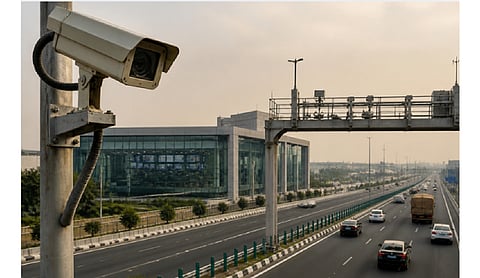

Over the past decade, Uttar Pradesh has built one of the largest high-speed road networks in the country. Corridors like the Yamuna, Agra-Lucknow, Purvanchal, and Bundelkhand Expressways have cut intercity travel times, while cities like Noida, Ghaziabad, Lucknow, Kanpur, and Varanasi have expanded their ring roads. To manage rising speeds and urban congestion across this network, state police and transport authorities have shifted from manual roadside checks to automated electronic surveillance.
Today, overhead gantries equipped with radar sensors and high-definition cameras monitor traffic flow day and night. Whether a commuter is crossing an intersection in Noida Sector 18 or cruising down the 165-kilometre stretch between Greater Noida and Agra, compliance is tracked digitally and linked directly to the central vehicle registry.
How Automated Speed and Junction Monitoring Works Across UP
In major urban districts under the Smart City Mission, Integrated Traffic Management Systems (ITMS) serve as the nerve centre of road enforcement. High-resolution cameras mounted at signalised intersections work alongside Automatic Number Plate Recognition (ANPR) software to spot infractions without requiring a traffic constable to wave down the vehicle.
On high-speed expressways, enforcement also relies on point-to-point average speed calculation as well as spot radar guns. If a passenger car covers the distance between two toll plazas faster than the statutory speed limit allows, the overhead system flags the registration plate automatically. Inside city limits, cameras routinely capture four common categories of violations:
● Stop-Line and Red-Light Infractions: Crossing the painted white stop line or entering an intersection after the signal turns red triggers an instant timestamped photograph.
● Safety Gear Non-Compliance: High-definition lenses identify two-wheeler riders and pillion passengers without helmets, as well as four-wheeler occupants driving without seat belts fastened.
● Lane and Flow Violations: Driving against the flow of traffic on one-way stretches or cutting across yellow lane dividers in heavy NCR commuter corridors draws immediate digital notices.
● Document Expiry: Once a camera logs a registration number for a moving violation, the backend system automatically cross-checks the Vahan database to verify whether the vehicle's third-party insurance and Pollution Under Control (PUC) certificate are active.
Statutory Penalties and the UP Electronic Notice Workflow
Uttar Pradesh enforces the penalty benchmarks established under the amended Motor Vehicles Act uniformly across all districts. Driving without a valid driving licence carries a 5,000-rupee fine, riding without a helmet or driving without a seat belt attracts a 1,000-rupee penalty, and overspeeding in a light motor vehicle draws between 2,000 and 4,000 rupees depending on the corridor and severity. Operating a vehicle without a valid Pollution Under Control certificate or blocking an emergency vehicle such as an ambulance can attract penalties up to 10,000 rupees.
When a camera or handheld enforcement device logs one of these infractions, the system generates an e challan UP notice tied to the vehicle's Registration Certificate. An automated SMS alert containing the challan number, offence description, and fine amount is sent to the mobile number registered on the Vahan portal. Because the record is stored centrally on the Parivahan database, a notice issued in Lucknow or Meerut is immediately visible to transport offices across the country.
Why Unpaid Notices Escalate to Virtual Courts and RTO Blocks
A frequent problem for vehicle owners is missing the initial SMS alert because their mobile number was never updated at the Regional Transport Office after buying the car, or because a family member was driving the vehicle at the time of the infraction. Ignoring a digital notice does not make it expire.
Under standard enforcement protocols, motorists are given a specific period to settle compoundable fines online. If the penalty remains unpaid past that window, the challan is forwarded electronically to the Virtual Court system. Once a matter reaches the Virtual Court or a local magistrate, the owner may face additional judicial processing steps. More importantly, unpaid challans can trigger administrative locks on the Vahan portal, preventing the owner from renewing a fitness certificate, removing bank hypothecation, or transferring ownership during a used-car sale. In addition, central transport norms enforced from 2026 allow licensing authorities to initiate driving licence disqualification if a driver accumulates five or more offences within a calendar year.
How to Audit and Clear Vehicle Records
Performing a routine pending challan check online once every few months protects both current owners and prospective used-car buyers from unexpected liabilities. Checking the status requires only the vehicle registration number, the challan number, or the driving licence number, along with basic verification details.
Once the digital ledger opens on the screen, the motorist should verify three details before making a payment:
Photographic Evidence: Open the attached camera frame to confirm that the registration plate, vehicle make, and body colour match the actual car.
Offence Location and Timestamp: Check the date, time, and city junction listed on the notice to ensure the vehicle was genuinely present at that spot.
Settlement Confirmation: After paying via UPI, net banking, or debit card, download and save the official receipt carrying the transaction ID.
If a camera misreads a plate and assigns a fine in error, owners can submit proof on the online grievance portal to have it cancelled.