
- HOME
- INDIA
- WORLD
- BUSINESS
- STATES
- LAW & JUSTICE
- ENTERTAINMENT
- SPORTS
- VIEWPOINT
- LIFESTYLE
- TECH
The rotor blades cut into the Dehradun morning just after six, and within minutes the foothills fell away beneath the chopper like a folded map opening itself out. This was not the leisurely unspooling of a road trip, where each turn earns its view. The helicopter to Gauchar compresses geography into fifty minutes — the Alaknanda appearing and vanishing beneath clouds, pine ridges stacking into grey-green corduroy, a village or two flashing by, gone before I could name them. This is the second time I had flown into pilgrimage, my first being Kedarnath a couple of years ago.
And honestly, I can’t thank the UDAN scheme enough for making pilgrimage accessible for people who cannot endure physical strain, whether because of age, health or plain mental block.
My ride was Heritage Aviation’s Airbus H130, a single-engine helicopter with a noticeably wider cabin and wraparound windows that put every seat within reach of a view rather than reserving it for whoever sits up front. The enclosed Fenestron tail rotor trimmed out most of the vibration and clatter that usually punctuates a chopper ride, so what stayed with me was the landscape, not the machine that carried me over it.
Gauchar’s airstrip sits in a bowl of mountains, unremarkable until you remember what it saves you: two days of hairpin driving compressed into breakfast. From there, the road to Badrinath took over, and I was glad of it. Some places should still make you work a little. The route hugs the Alaknanda for most of its length, past Joshimath’s terraced slopes, through tunnels blasted into rock that opened suddenly onto views of a valley narrowing with altitude. By the time Badrinath’s temple came into sight, that unmistakable saffron-and-blue frontage against the Nar-Narayan range, the light had turned the particular gold that high Himalayan afternoons keep to themselves.
I will not pretend the temple town is peaceful in the way brochures promise. Badrinath is loud with devotion: bells, chants, the hiss of Tapt Kund’s hot springs where pilgrims bathe before entering, steam rising into cold air like something alive. I queued with the rest, the stone floor warm under bare feet from bodies that had stood there before mine, and inside the sanctum the priest’s chanting folded into a rhythm older than any itinerary. What stayed with me wasn’t the darshan itself, brief as these always are, but the time I spent within the temple, immersing myself in kirtan that was being held at one of the compounds. These are the moments when you just surrender, empty out the load that you have been carrying within and before you know, you are healed.
As I walked back out, the Alaknanda roared below the temple and Neelkanth peak caught the last sun. My eyes skimmed over pilgrims of every age who sat along the ghats simply watching the water, in no hurry to leave. As it is, the hotels at such pilgrim towns are focussed on comfort over luxury for weary pilgrims. I was parked at Hotel Royal Badri – a Pilgrim’s Habitat for the night. What warmed me to the place was its hospitality concept that centred around the needs of the pilgrims in sync with the devotional mood of the moment. Equipped with ritual-ready spaces, clean and quiet rooms were perfect to shake off travel fatigue and provided the comfort that one sought after an intense spiritual experience. Fresh after a long bath, I savoured the most amazing Kumaoni thaali, prepared on request by the kitchen team. A perfect end to an emotionally heavy day.
I set off for Govind Ghat by road the next morning. This is the gateway for both Shri Hemkunt Sahib and the Valley of Flowers, and the town exists almost entirely in service of that fact: mule handlers, porters, small dhabas selling parathas to trekkers before dawn. I had expected to walk the 13 kilometres to Ghangria. An old knee injury made that unwise, so I took the chopper instead, a short hop that trades a full day's trek for eight minutes over pine forest and waterfalls that the walking route only glimpses sideways. Pawan Hans runs the shuttle service that can be booked in advance and at the spot, depending on availability. There is a particular guilt in flying past a trail that pilgrims twice your age are walking on foot, prayer flags tied to their sticks. I felt it, and flew anyway. Ghangria itself is a base camp with a pilgrimage’s worth of order to it. Everyone there is headed somewhere higher the next morning, and the evenings have a bustle to them: wood smoke, the murmur of langar being prepared, boots drying by small stoves before an early start and massage services for weary feet that have endured the arduous trek. I chose Shri Hemkunt Sahib first, six kilometres of steady climb to a lake at over 4,300 metres, ringed by seven snow peaks that give the gurdwara its name. The deep spiritual importance of Shri Hemkunt Sahib is rooted in the Sikh scripture Dasam Granth. In it, the tenth Sikh Guru, Guru Gobind Singh, mentions that in a previous incarnation as Dusht Daman, he performed long and intense meditation at a place surrounded by seven snow-capped peaks — a site known as Hemkunt Parbat Sapt Sring. The site remained hidden for centuries due to its extreme geography. It was in the early 1930s that Sant Sohan Singh, a retired army soldier and devout Sikh scholar, meticulously researched the descriptions in the scriptures and explored the Garhwal Himalayas until he successfully identified the glacial lake. What makes it even more distinct is that Shri Hemkunt Sahib is built in a distinct pentagonal shape. It was architecturally designed to withstand the heavy winter snow and harsh Himalayan conditions. The cold at that altitude has a clarity that no amount of description quite carries across. It simply arrives, along with the sound of the Guru Granth Sahib being recited across still water, and the sight of other Sikh pilgrims, many far older than me, completing a circuit I was already finding difficult. I sat by the lake longer than planned and soaked in the peace that was almost surreal. The gurdwara premises are cleared out at 2 pm everyday, allowing pilgrims to make a safe descent. Altitude can be a challenge for pilgrims and you are advised to stay suitably hydrated. For those who cannot make it on foot, there are pony and pitthu services that allow you to choose how to complete your journey over giving up. Just make sure to book at the base to avoid having to succumb to inflated rates should you wish to switch midway. Next to the gurdwara lies an ancient temple where Lakshman is believed to have meditated. It marks the believed site where Lakshman performed penance and meditation to recover his strength after defeating Meghnad in the Ramayana.
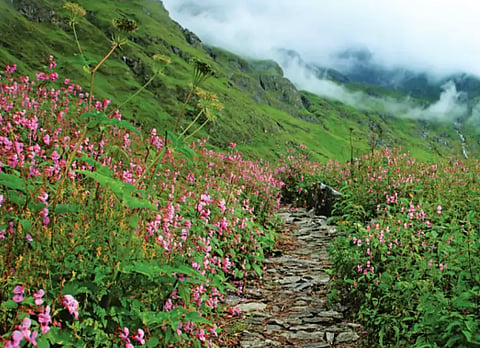
The Valley of Flowers, the next day, asked for patience of a different kind. It reveals itself slowly. You walk through forest and moraine for the better part of two hours before the meadow opens, and even then the flowers arrive in waves rather than all at once: blue poppies first, then anemones, then the deeper reds of Indian paintbrush further in, depending on where the monsoon has reached that week. Then there is the Brahma Kamal, a rare species that only grows in this region. It is also the national flower of Uttarakhand. I had read that late July catches it at its fullest. Exhaustion washed all over me as I completed this leg, but there was peace at having completed the circuit. The return chopper from Ghangria to Govind Ghat closed the loop the way these journeys often do, quickly, almost too quickly, the valley shrinking below until it was only a green crease among white peaks. Watching it go, I thought of how differently the same stretch of Himalaya had unfolded depending on whether I had walked it, driven it, or flown it. Each mode gave up a different truth but together, it made for an experience that will remain etched in my memory for a lifetime.