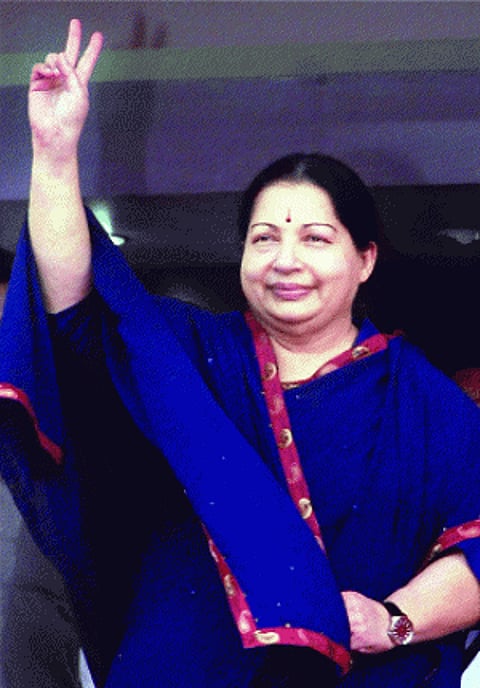

J Jayalalithaa redefined politics of Tamil Nadu
Tamil Nadu has had many Chief Ministers, but there was none like J Jayalalithaa. Revolutionary leader (Puratchi Thalaivi) and Amma to the masses; a woman of substance and a politician of steel to those who dealt with her or crossed swords with her; aloof to the world but tender and compassionate to the few who were close to her, she was an enigma. Her charisma was enough to keep the AIADMK from sinking in the worst of crises and soaring in the happiest of moments. She fought many battles, both political and personal, in her journey to the top. There were moments when the less resolute would have given up. But Jayalalithaa was made of a different mettle. She lived by her norms, and by her definition, and used these qualities to be a step ahead of her rivals and in sync with the masses whose loyalty to her bordered on the hysterical. She once famously remarked in a media interview, “I give as good as I get or even more than I get.” Anything less than this determination (call it arrogance or ruthlessness or pragmatism), would have long extinguished her political career. This is more so, given that her struggle to the pinnacle was both personal and professional. Who can forget the scenes of humiliation she suffered when her mentor and founder of the AIADMK, MG Ramachandran (MGR), passed away. She had been rudely pushed out of the carriage holding MGR’s mortal remains, by people close to his family. She had been snubbed and abused. She was just MGR's protégé then, and the cabal close to his family believed it could now show the lady her place. But the obvious sincerity in her grief and the insults she braved with dignity won her millions of followers and catapulted her to the top within the party.
It was not the first time she had faced personal slight. For some months, a rift had developed between the mentor and the student and it reflected when MGR took ill and was hospitalised. He had by then completely cut her off. But she bounced back, no doubt because the charismatic MGR was impressed by her dedication and had possibly seen through the shenanigans of her opponents within the party. When she took over the mantle after MGR's death, few believed she would be able to keep the flock together — more so being a woman in a male-dominated party, being born and brought up in Karnataka and speaking Kannada more fluently than Tamil, and a Brahmin in an anti-Brahminical party. But she did it splendidly. Along the way, though, experiences which personal turmoil brought, turned her into an introvert and wary. This is paradoxical because with her party cadre and the people, she was all charm and warmth, and supremely confident when it came to political matters. In her own words, the personal and political upheavals had made her into a “very different person”.
Her political legacy is difficult to define in a sentence. But if there is one aspect that stands out tallest amongst her many achievements, it was her remarkable ability to connect with the concerns of the ordinary citizen, and offer them relief. The hugely popular ‘Amma’ brand of welfare measures is testimony to this. She fitted to a ‘T' John C Maxwell's observation: “A leader is one who knows the way, goes the way, and shows the way.”