
Goods and Services Tax in its present form is not the end. It’s a beginning of genuine future reforms. One hopes the dream of ‘one economic India’ will come true eventually
India’s internal trade gross domestic product (GDP) ratio, at about 54 per cent, is comparable to that in other large countries. India has, for nearly 70 years, affirmed and re-affirmed the political “idea of India”, is de facto and de jure one economic India, observed Economic Survey 2016-17.
“The inter-State trade is 1.7 times larger than the country’s international trade of 32 per cent of the GDP”. India’s trade profile is thus more similar to that of China at 1.6 times its international trade but less than the US, whose internal trade is 2.5 times its international.
The observation is significant on the eve of the ceremonial launch of the Goods and Services Tax (GST) from the Central Hall of Parliament House. It means, Indians have ingenuity and passion to integrate the country. language or political regionalism is not a barrier in internal trade expansion. Despite many hurdles — more bureaucratic or rule-based — the integration is amazing, the survey notes.
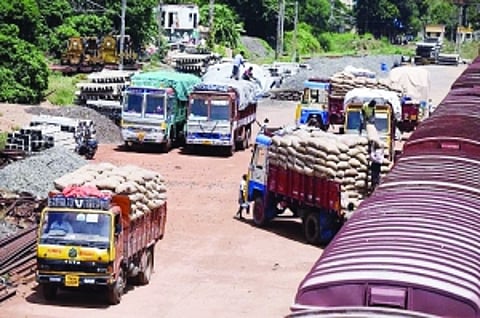
The survey has come down heavily on impediments on truck movements on State borders “with their drivers haggling for official clearances or subject to extortion”. The GST possibly is not addressing these issues as of now. It may gradually pave the way for smoother movement. But the new GST — one national tax with four different components or taxes — is ignoring it.
Ideally, it should have done away with highway and other tolls (municipal etc) despite multiplicity of road, parking and fuel cess on transport movement. “The consequent damages to trade and economic activity too have been extensively catalogued”, the survey notes. This is despite the fact that the Indian society is extremely mobile, a dream of father of the Constitution, BR Ambedkar, for conveying a change.
But the costs of movement are about twice as great. The survey attributes it to the current indirect taxes. It, however, does not refer to the inter-district police barriers and jumbling of vehicles at inter-city borders due to tolls levied by local bodies. The GST presently is not addressing the issue apparently. The survey hopes that the GST “by ironing out oddities may normalise inter-State trade”.
According to a recent report published by the Transport Corporation of India (TCI) and Indian Institute of Management Kozhikode, such delays impose transaction costs of over one lakh crore rupees ($21 billion) annually on India’s businesses. In addition, it increases the average transit times and makes supply chains inefficient.
Enabling seamless movement of goods across India is, in fact, considered to be one of the most important aspects of GST-related reforms.
The rules of transport-related documentation and administrative procedures, for checking and inspection of trucks, though usually unnecessary and often severe duplication, so far has not received attention.
The National Highway Authority of India says that it is digitalising toll gates. It conceals the fact that the tolls are additional and unnecessary tax as already several kind of road taxes are levied on truck, bus and other transport movement. It is an additional cost. Each toll gates, despite supposed electronic control, adds to travel time and creates barriers.
With one GST, check posts at State borders need to be completely eliminated. Presently, a plethora of forms are needed to be filled up to satisfy the State road transport authorities and also pay an additional road tax, in some cases even with a national permit.
The system of inspectorate — that thrives of what the survey notes as extortion — has to be done away with. Apart police and Regional Transport Office posts levy “taxes” amounting to about Rs 28,000 crore a year
The GST Network (GSTN) that has already come out with an IT architecture has to broaden it to include the goods movement. Instead of each time demanding hardcopies of invoice and forms, it should create an automatic ID to end the discretion of inspecting officials. A system of trust has to be built.
The official system is based on the concept of mistrust. The human element is missing in it. Distrust apparently is the creation of the not so honest officials so that extortions can go on. Even the GST has to be widened beyond taxes to create a system of having seamless movement across States.
The GST Bill has provisions for substantive powers for stoppage and seizure of vehicles, which can be potentially abused. The nation has witnessed how the local police abuses these provisions leading to lakhs of vehicles being turned into junks at police stations, often just for the reason that someone has not paid the slush money. This is a severe penalty and soar business costs; causes uncertainty and hampers trade.
Such clauses should gradually be out of the law books so that the business and trade can thrive, jobs can be created and the happiness that India aspires for may become real. Yes, that would boom national and State GDP too. There is no rationale for holding goods at police posts for non-payment of a small amount of tax. This can be sorted out in ways other than punitive.
President of Global Trucks, Anuj Kathuriam, at the recent zonal conference told the media that he hoped that tolls and restriction on movement is set to go with the GST and goods could now
move with ease. Such ease of rules has larger benefits. It not only makes movement easier, but also increases demand and boosts manufacturing at all levels, including automobiles.
Removal of barriers can help the laggards. The survey says the so-called laggards like Uttar Pradesh and Haryana are the manufacturing powerhouses not just Tamil Nadu and Gujarat. Uttar Pradesh is a net exporter, and hence competitive in manufacturing.
There is a strong correlation between a State’s manufacturing share of State’s GDP (GSDP) and its trade volumes (as per cent of the GSDP).The manufacturing prowess of States is associated with higher inter-State trade.
The fundamentals of India’s provincial trade compare with the best in the world — Canada, the European Union and the US. These are governed by the four freedoms — allowing unfettered movement of goods, services, capital and people. India’s internal trade data is understated as it does not include agricultural products. So the road to progress in India is enormous provided the man-made barriers are eliminated.
The GST in its present form is not the end. It would be a beginning of the real future reforms. One hopes the dream of one economic India would succeed with it.
(The writer is a senior journalist)