
Pivotal time for Pakistan after ICJ directive
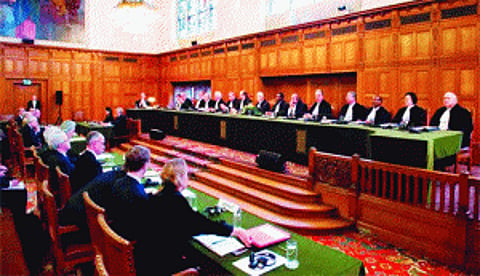
The sham trial by a Pakistani military court which sentenced Indian national Kulbhushan Jadhav to death has been exposed with the International Court of Justice (ICJ) ordering a stay on the execution. It remains to be seen whether Pakistan honours the Hague-based court’s directive, because it is a country which is not known to keep international commitments; it has repeatedly violated the spirit of the Shimla Agreement. In the present instance, ever since Jadhav was picked up by Pakistani authorities, the Indian Government made as many as 16 requests to Islamabad for consular access under the Vienna Convention on Consular Relations of 1963 — of which Islamabad is a signatory — but Pakistan chose to ignore every one of them. Nor had Pakistan followed a transparent and fair legal process which is the hallmark of a truly democratic country; the trial was conducted in secret by a military court and there is no certainty whether Jadhav had been extended competent legal support to present his case. Pakistan can now claim that the ICJ stay is only technical in nature and that the last word has not been said yet.
But it cannot run away from the fact that no international court would order a stay on the verdict of a court of a sovereign nation unless it was deeply convinced of wrongdoing. Senior lawyer Harish Salve, who represented the matter before the ICJ, had focused on the dubious manner of Jadhav's arrest, framed-up charges and denial of consular access as reasons to seek immediate relief from the international court. let's now see what the ICJ eventually adjudicates. For the moment, we must pray that Jadhav is not conveniently done away with, in prison. While the relief has been welcomed across the political spectrum in India, the Congress has strangely expressed reservation over the Centre’s decision to move the ICJ, claiming that the Modi Government may have opened the doors for Pakistan to internationalise the Kashmir issue and demand third-party mediation. In the first place, the Jadhav case has got nothing to do with Kashmir. Second, Pakistan has already internationalised the Kashmir dispute — and with no great advantage to itself. And third, outside mediation is something that Islamabad has been pleading for decades, and to no avail. The few countries which offered their ‘good services' quickly receded, after New Delhi made its displeasure known. India knocked the doors of the ICJ after it became evident that Pakistan was in no mood to listen to reason and was determined to hang Jadhav on trumped-up charges.
Given that Pakistan is fast turning into a rogue state, it would be interesting to watch whether it respects the international court's order. Already there are hardline voices from there, that are instigating the Nawaz Sharif Government to ignore the ICJ and hang the ‘spy and terrorist' Jadhav. There is an interpretation that the ICJ's stay order is a blessing in disguise for Prime Minister Sharif as it strengthens his hands and leaves the Pakistan Army embarrassed — after all, an Army court had done the trial and passed the capital punishment verdict. Even if this is so, it is not clear how Sharif is going to use his relative ‘strength' for now. The Army still holds the key to his acquittal in the Panama Papers issue.