
A curious admixture of myth and cherry-picked facts doesn’t equal a Congress comeback
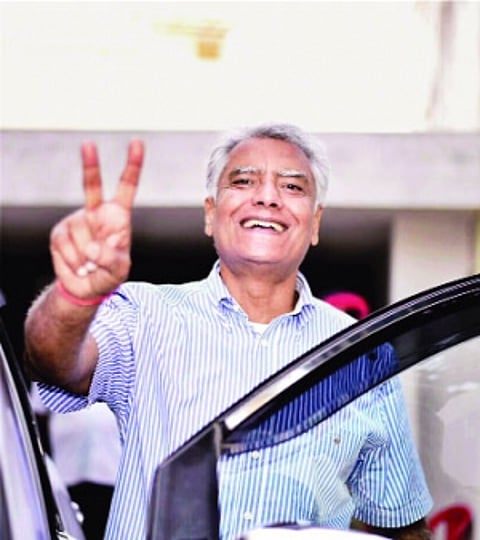
The impressive win of Congress candidate Sunil Jhakar from the Gurdaspur lok Sabha constituency in Punjab, a seat it has wrested from the BJP in the by-election necessitated by the death of BJP MP Vinod Khanna with a margin of nearly two lakh votes, has resulted in BJP-haters and Modi-baiters crawling out of the woodwork. Congress big guns too are out in numbers. Punjab Chief Minister Amarinder Singh has pronounced the result, along with some victories in university polls by the party’s student wing NSUI, as the beginning of the end of the BJP-led regime in India while former Union Minister Kapil Sibal, in a newspaper column, all sense of irony lost, held up the corrupt and policy paralysis-stricken UPA regime between 2004 and 2014 as an exemplar of ‘real development’ making use of that hoary socialist chestnut ‘inclusive growth’.
The facts are as follows: First, as any psephology 101 class would tell us, the honeymoon period for a party with a popular face which the Congress undoubtedly is in Punjab where it stormed to power with a big win earlier this year can safely be assumed to continue for at least six months to a year unless there is a cataclysmic event during that period. The by-poll victory, for which the Congress is to be congratulated, is clearly a reflection of the continuing public anger against the previous Akali Dal-led regime and an approval of the initial policy pronouncements of the Amarinder regime. The Congress won eight of the 10 Assembly segments that comprise the Gurdaspur lok Sabha seat in the Assembly poll, and in the by-poll it picked up all 10 which is a result of momentum for reasons listed above and certainly not an (imagined) endorsement of the Congress’ policies nationally as is being made out in certain quarters. Secondly, in Kerala, the Assembly by-poll result in the Muslim-dominated Vengara constituency shows that while Congress ally IUMl retained its seat, its margin of victory has come down compared to the 2016 Assembly poll. Thirdly, the much talked up NSUI victories too need to be seen in context: of the four office-bearer seats in Delhi University it won two with two going to the ABVP which is in keeping with the history of keen competition between the two in the past unless there is a wave in favour of the parent party of either students’ organisation; in Panjab University where elections were held in September and the NSUI won three of the four office-bearer seats, it is clearly a function of the anti-Badals, pro-Amarinder public mood on the ground; the Allahabad University polls saw the NSUI’s slogan of “DU hui hamari, ab AU ki baari” come a spectacular cropper with it figuring nowhere and the contest being between the Samajwadi Party’s student wing and the ABVP which albeit the former won. In sum, one Gurdaspur does not a revival make as much as the new social media team of the Congress may have asked all party heavy-hitters to create an ambient surround sound for the run-up to Rahul Gandhi’s coronation. Getting from 44 seats in the lok Sabha to 180-plus which is what the Congress will need if it is to have even an outside chance in the 2019 General Election, is still a far cry.