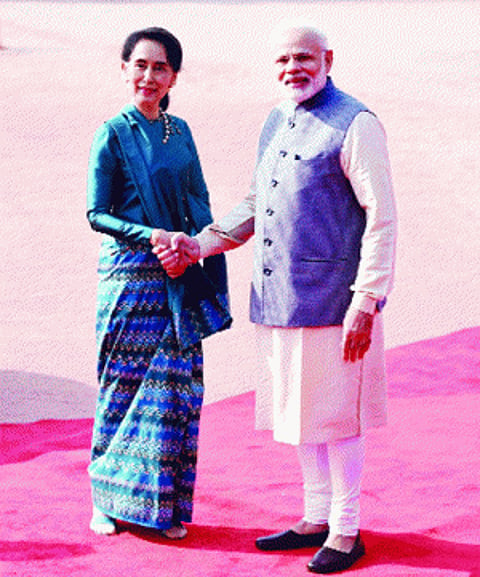

Suu Kyi, key to success of Bimstec functioning
The visit of Myanmar's State Counsellor and Foreign Minister Aung San Suu Kyi to India should help rebuild ties with the neighbour. Her presence was of special significance as it happened right after the Brics (Brazil, Russia, India, China and South Africa) summit and as part of the first diplomatic outreach of the Bay of Bengal Initiative for Multi-Sectoral Technical and Economic Cooperation (Bimstec). The South Asian Association for Regional Cooperation has become a dead forum for the time being, because of Pakistan's irresponsible behaviour. In this changed scenario, the Bimstec group of nations, with more than 1.5 billion people and a combined gross domestic product of more than $2.5 trillion, can bring South and Southeast Asia closer than ever before.
India’s outreach to Myanmar will help the country explore new possibilities. Energising the Bay of Bengal initiative has its own benefits as there will be no more intervention from Pakistan. The Bimstec countries could also be an effective forum to fight counter-terrorism emerging from Pakistan. This is evident in the Bimstec leader's Retreat 2016 Outcome Document issued on Monday. It slams the states which ‘support and finance terrorism, provide sanctuary to terrorists and terror groups'. Beyond this, the document also highlights that ‘there should be no glorification of terrorists as martyrs', giving a veiled reference to how Pakistan hailed the late Hizbul militant Burhan Wani as a ‘martyr'. Bimstec is the way forward for India to play a crucial role in reshaping the economic, political and strategic calculus of the subcontinent minus Pakistan.
Though India maintained cordial relations with Myanmar’s military junta in the past, but with a democratic regime in power with Suu Kyi as de facto leader, we must forge ahead and redefine our ties in the changed contours of the Act East policy. When she came to India in 2012, as the opposition leader of the National league for Democracy, Delhi had foreseen her chances of taking over the leadership of Myanmar. But when she finally took over, she chose to pay a visit to China first. As China holds the key to bringing peace with ethnic terrorist groups in the country's restive western region, she had to ensure the support of Beijing.
Besides strengthening people-to-people cooperation, her visit to India will open new opportunities for investment in one of the most backward nations of Southeast Asia. Suu Kyi's tour could also be seen as a follow-up of Myanmar President Htin Kyaw's visit in late August to India. During his visit, both the countries signed four memorandums of understanding: Cooperation in the field of traditional medicine, renewable energy, infrastructure development and the upgradation of the approach road to the Tamu-Kyigone-Kalewa highway. Myanmar's support to India is crucial in fighting the insurgent groups like the United liberation Front of Asom, National Socialist Council of Nagaland (K) etc operating in the North-East. In the recent past, Delhi received full cooperation from Nai Pyi Taw in conducting counter-insurgency operations even within the territories of Myanmar. As India shares a long border with Myanmar, building close relations with that country will not only bring home economic benefits but also rejuvenate old cultural bonds.