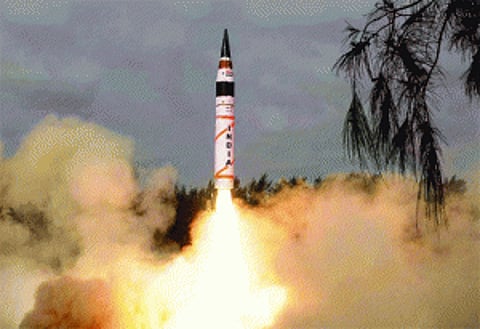

Agni V done, now for Agni VI with better range
The successful test firing of Agni V, India’s most advanced ballistic missile, off the coast of Odisha, is a milestone achievement in India's quest for nuclear security. From Agni I to Agni V, it has been a long journey for the Defence Research and Development Organisation (DRDO) and also for this country in developing indigenous nuclear missile technology that can strengthen the country’s nuclear deterrence programme. It is indeed commendable that all missiles — be it short-range ones like Dhanush, Prithvi, Agni I, Agni II and Agni III, or long-range ones like Agni IV and Agni V — have come out with flying colours, baring a few technical glitches. The credit for this goes to the meticulous planning of our missile scientists in the DRDO. With Agni V, India has made an entry into the super-exclusive club of nations (which includes US, Russia, China, France and the UK) whose ballistic missiles with nuclear warheads can reach far distances. The most striking feature of Agni V is that it has a target capacity of more than 5,000kms and can carry multiple warheads from land, water and sea. No Indian nuclear warhead missile has ever had such a striking range until now. A combination of long-range strike capabilities, low maintenance cost, longer shelf life, enhanced mobility and the capacity to carry multiple nuclear war heads, each programmed to hit different targets, is the best bet our country can have.
However, there is no barrier to improvements. If reports are true, Agni VI, which is being given the finishing touches by the DRDO, will have a striking range of about 8,000kms to 12,000kms. Indeed, the sky is the limit. But despite this big achievement, India lags behind countries in the elite group. Topping it all, Russia has the world's longest range inter-continental ballistic missile with a striking range of 16,000kms. Following next is the US, with a range between 12,000kms and 15,000kms. The US is followed by China at 13,000kms, and France at 8,000kms to 10,000 kms. There's a long road ahead for us before India's missile programme is virtually complete. Strategically, the missile has come as a fillip to defence technology. Given India's commitment to no-first-use of nuclear weapons, it can well be said that India's second-strike capability is now covered.
The missiles are definitely prized assets for the country and for our forces, but the achievement must go hand-in-hand with a competent Armed Forces — the Army, the Navy and the Air Force — which is gravely under-staffed and facing multiple challenges. The Indian Army is in urgent need of reforms. Arms and ammunition have become dated, many of our soldiers do not have access to proper uniforms, defensive gears such as helmets and bulletproof jackets. The Navy, which functions at times on the jugaad culture, is in urgent need of equipment. There is an acute shortage of breathing and safety gears. As for the Indian Air Force, it faces acute shortage of manpower and is in dire need of upgraded aircraft. In a scenario when complexities around the world have increased manifold and are bound to rise further, and global powers have been threatening one another, it becomes all the more important for a developing country like India to set its priorities right and secure itself from any threat that may arise.