
So-called Third Front sounds nice only on paper
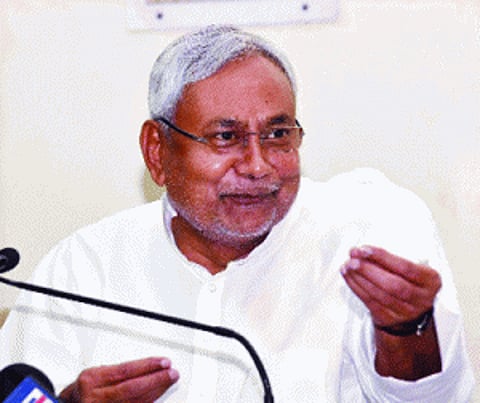
Bihar Chief Minister Nitish Kumar hopes to stitch together an anti-Bharatiya Janata Party alliance across the country. His Sangh-mukt cry may resonate with the parties that were mowed down by the Narendra Modi phenomenon in the 2014 lok Sabha election, but that does not mean they will readily accept Nitish Kumar's leadership to create a broad-based anti-BJP combine. The Congress has already hinted that, while it welcomes the Bihar Chief Minister's call, it would be the lead partner since it alone has a pan-India presence. Nitish Kumar's dream of emerging as a national symbol against the BJP may, therefore, hit a roadblock sooner than later.
But he is not giving up so early; he dragged in the Rashtriya Swayamsevak Sangh as well, saying the country needs to be free of the RSS too. This is a tall order, and the Bihar Chief Minister knows it well. But he believes such statements will fetch him the desired stature to stride the national stage. In a democracy, parties are free to pool their resources against opponents. But both the present situation and past experience lead one to view such attempts with scepticism. The biggest regional parties that matter — the Samajwadi Party, the Bahujan Samaj Party, the Biju Janata Dal, the AIADMK, the Trinamool Congress — are strong enough on their own and they will gain nothing by becoming part of an anti-BJP combine where their positions can be compromised. In addition, there will be the leadership tussle.
Moreover, those like the Biju Janata Dal and the AIDMK have not been unduly antagonistic towards the BJP-led Government at the Centre, while the Samajwadi Party and the Bahujan Samaj Party often calibrate their responses to the BJP on a case-by-case basis. It's difficult also to see both the SP and the BSP on the same side of the political coin, just as it's virtually impossible to have the AIADMK and the DMK in one grouping. In other words, at best only a few of these will join a possible coalition, thus leaving the new entity emasculated from the start. One may recall the fiasco of the so-called Samajwadi parivar coming together, after Mulayam Singh Yadav walked out of a grand SP-JD(U)-Rashtriya Janata Dal combine in the run-up to the Bihar Assembly election. Even the left parties, great proponents of a Third Front, had given up in desperation when they realised the impossibility of the project. Minus the important regional satraps, a national front against the BJP is a non-starter.
Also, experience shows that the anti-BJP glue alone will not work, just as the anti-Congress adhesive failed to hold the Janata parivar together in the late 1970s. Constituents of the Janata Party went their separate ways — and also splintered in the process — when the anti-Indira Gandhi euphoria began to wane and the inherent differences between the constituents began to surface. Similar differences exist today among the anti-BJP and non-BJP/non-NDA parties as well, and they will not be mitigated by the rallying anti-Sangh call. At best, arrangements at State-levels can be made, just as they were in Bihar and are now in Tamil Nadu. The Congress can experiment with loose understandings (as with the left in West Bengal) and assume subordinate roles (as it has in Tamil Nadu), but a grand, national anti-BJP alliance, appears a mirage for now.