
India must take lessons from the US presidential election result, where the middle class wanted the new President to end the jihadi challenge and voted for one who promised a no-nonsense approach
Days after America was surprised by the election of Donald Trump, soul searching is on in that country: The question troubling the soul of America is how did its institutions, for all the resources they could muster as the most powerful country in the world, fail to detect the sound of the vast electoral upset, that it brought a person so despicable that even his own party leaders gave him up as a liability, got so wide an electoral support to win against a popular opponentIJ
“Surprising alarm, and alarming surprise”, TIME magazine editorially characterised the triumph of Trump. But it did not fail to acknowledge that the campaign and the upset result “political experts were serially humiliated by events that defied every prediction they’d made”. “No institution came through unscarred — certainly not the Press...” The magazine then listed the vast resources it deployed in the election coverage, “A range of contributors from Princeton professor…to political analyst...to retired Admiral…creative director…” the list looks awe-inspiring as well as the best the US could give.
This is in addition to the army of reporters at every level. Several other journals, including the redoubtable New York Times, went through this soul searching exercise. The sum and substance of the search was the finding that journalists and several other idea-men substitute their won preferences, their own hopes as conclusions, imaginations and predictions get mixed up and journalists drift away from their professional obligations — that is, report the truth, however, unsavoury.
It’s not just America where journalists get caught up in their own ideologies or hopes and dreams and, to a great extent, reality, that they are ethically bound to report, becomes a victim. In the last general election, we saw this in many a dispatches where the leading party and its prime ministerial candidate were shown in pejorative perspectives till the reality when it emerged . It hit them like a bombshell and they began the process of adjusting themselves with it.
If you carefully analyse the reportage since 2014 May, you would be wondering why the Government, with a solid majority in the lower House, is shown as falling from one crisis to the other. Even the latest set of reports, on what is described as demonetisation, gives the impression that the Yamuna is on fire when the fact is that the public has to undergo a series of adjustments.
Interestingly, the series of by-elections and local body elections in different States have shown the BJP as retaining its popularity despite the long queues before banks and ATMs. Not even one sign is there of a popular apprehension of a collapse in the public confidence of the country’s economy or much less its currency for all the sufferings people undergo without adequate change to deal with the day-to-day requirements.
There is, of course, a line or two in these reports of the very people standing in the queue, also saying they understand the benefit of this demonetisation and, hence, support it. But these lines get buried in the avalanche of ATM queues. The journalist in the reporter should have explored the meaning of the same person complaining the current discomfort and yet supporting the scheme itself.
Such exploring would have satisfied the curiosity that should be the core of every journalist. But that would have been in conflict with the hope that the Government is going to or has to collapse in the wake of a very difficult but politically courageous decision. Journalists who have the privilege of the ringside view of history should be the first to acknowledge political courage whenever they see one act of such courage because that is so rarely seen in action.
However, even within what is described in newspaper reports as “combined Opposition” there are leaders who can see miles beyond the next election. The Nitish Kumar-led Janata Dal (United) and the Naveen Patnaik-led Biju Janata Dal have had the political courage to not associate themselves with the other Opposition leaders in protesting against demonetisation even as they kept highlighting the public suffering.
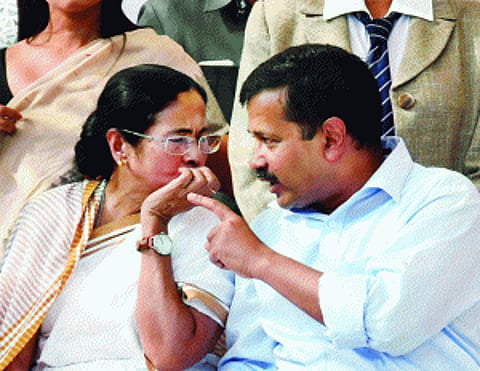
On the other hand, Delhi Chief Minister Arvind Kejriwal joined the Opposition melee. He seemed to have given his days as an anti-corruption crusader the go because he hopes to skyrocket to the national scene and even sees himself as the next Prime Minister in-waiting. But the reality is that his associates, one by one, are getting picked up by the Delhi police for alleged criminality.
What happened in Kerala where the State police gunned down Maoists led by an Andhra extremist, contrasts how activists and their journalist friends, get caught up in their own net if they begin to see every police action againstjihadis and Maoists as a false encounter. True, the security forces may occasionally go overboard — in Kashmir the Centre has investigated Army officers stepping out of their line of duty and trying to cash in on created encounters.
But to see every encounter as a possibly false one, is to demoralise the security men and strengthen the extremists. In Bhopal, the Press went hammer and tongs at the police when it shot down eight jail escapee jihadis. Then in north Kerala the State police traced down a Maoist group and in the encounter the extremists were killed.
The Marxist-led State Government is caught in a cleft stick with the Press and some Marxists questioning the encounter story despite the leader of the Maoist gang having been identified as one of the most wanted country-wide. When encounters take place, there are accusations that the security forces have not prepared for such attacks by extremists and infiltrators but why should the security forces risk accusations of manslaughter if in foreclosing attackers, some of them get killed and the Press and human rights activists go all out to paint the security forces in the darkest colourIJ
The jihadi and other extremist forces are now challenging the Indian state with new methods of infiltration and new weapons. If so, curbing them will have to be not with kid gloves but with an iron fist. There has to be a wide understanding of the challenges involved as the security forces are not involved in mere law and order issues; neither the jihadis nor the Maoists are interested in small crime; they are aiming at destroying the Indian state itself.
It would be helpful for all of us to take a lesson from the American election result, where the large middle class wanted the new President to end thejihadis challenge and voted for one who promised a no-nonsense approach, including wholesale barring of Islamists’ entry and deporting of three million illegal entrants.
(The writer is a Rajya Sabha MP and political commentator)