
GST reflects spirit of cooperative federalism
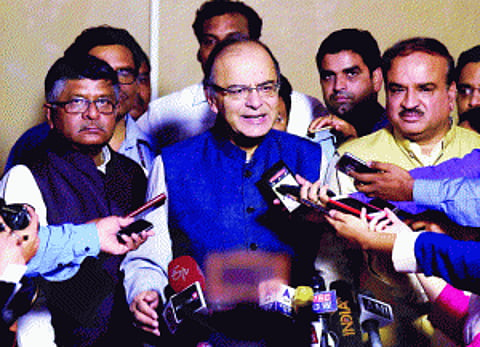
The passage of the Goods and Services Tax (GST) Bill in the Rajya Sabha on Wednesday can well be regarded as one of the rarest moments of ‘political consensus' achieved by the Modi-led NDA Government. This Bill, once it becomes a law, will truly reflect the spirit of ‘cooperative federalism' as proclaimed by Prime Minister Narendra Modi. The country must hail the spirit of togetherness displayed by the members of all political parties, barring the All India Anna Dravida Munnetra Kazhagam, who staged a walk out, for bringing an end to the decade-long wait for heralding a single indirect tax regime across the nation. Considering pragmatic aspects of the Bill, it can be rightly enumerated that this historic single tax regime is crucial to enhance the ‘ease of doing business’ in India and address the prevalent ambiguities of the indirect tax landscape which has proved to be utterly confusing and contradictory at times for big multi-national corporations, investing in India. The way Union Finance Minister Arun Jaitley built up consensus on the complex issues pertaining to the GST Bill, across the political parties, despite facing stiff opposition from the Congress, is laudable. As the GST broadly symbolises ‘one nation, one tax', the investors have widely called it as a ‘silver bullet' for India's economy which will eventually supplant multiple Central and State levies that directly inflates costs of doing business across the States.
On record, the GST Bill was voted by all 203 members present in the Rajya Sabha in the 244-member House. To pass this crucial Constitutional Amendment Bill, the Government needed the support of at least two-third of the members present and voting in the Rajya Sabha which finally was accorded amid the high drama consistently created by the Congress in the past. While receiving support from the Congress on the GST Bill, officially termed as the Constitution (122nd Amendment) Bill 2014, the NDA Government refused to yield to the former's pressure to put a GST rate in the statute. But the Government has acceded to the demand of the Congress to drop the additional levy of one per cent mentioned in the Clause 18 of the original GST Bill earlier that intended to compensate the manufacturing states of the said duty for a period of two years or more for the loss of revenue. Also, Clause 19 in the new Bill, which now reads as ‘Parliament by law shall compensate States as opposed to the words may which was mentioned earlier' will help dealing with the compensation to states for a period of five years or more towards the losses they may all suffer on the event of shifting to the new tax regime. Further, Jaitley had refused to give a commitment to the move brought by a group of members led by senior Congress leader P Chidambaram that an assurance be given that as and when he would introduce any subsequent legislation to operationalise the GST, it would be included in the category of finance Bill, not as money Bill. This could be observed as the last moment effort from the Opposition, particularly the Congress, to come up with a unique pressure tactic to categorise any changes in the GST legislation under the purview of the finance Bill so that the Rajya Sabha has a definite say wherein the party can play its card. Else, when it comes as a part of the money Bill, Rajya Sabha will simply has to pass it. Hope the single indirect tax regime will bring a new era in the post-liberalised economy.