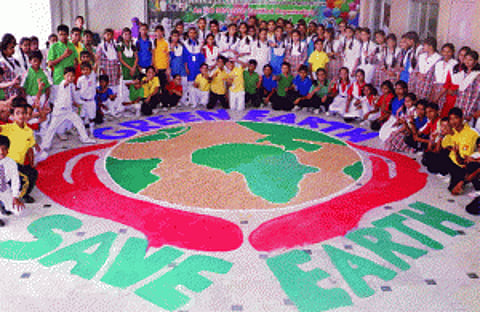

The Trump regime needs to remember the efforts put in by people like Senator Gaylord Nelson and his successors, before dismissing a worldwide threat as a mere hoax
It was the vision, commitment and initiative of a remarkable political leader in the US, Senator Gaylord Nelson, which led to the institution of Earth Day, and which, as in previous years, was observed on April 22 this year. Senator Gaylord Nelson was perhaps the first legislator in a developed country to understand that human progress cannot take place against a background of escalating environmental damage. He believed: “Environment is all of America and its problems. It is rats in the ghetto. It is a hungry child in a land of affluence. It is housing not worthy of the name; neighborhoods not fit to inhabit.”
He was a pioneer in introducing environmental legislation in the US to cover a range of environmental challenges, including the National Environmental Education Act. It was in 1969 that he came up with the novel plan to organise a day in the year when teach-ins would be held all over the US, to promote awareness and knowledge on the environmental problems facing the country. This accorded with what Confucius had said over two and a half millennia ago, “If you think in terms of a year, plant a seed; if in terms of ten years, plant trees; if in terms of a hundred years, teach the people.” Thus, Earth Day was born on April 22, 1970, when 20 million people gathered to confront their ecological problems at the level of cities, States, the nation and planet earth. He chose a young 25-year old, Denis Hayes, from his State of Wisconsin to organise the first Earth Day, and later Hayes expanded the observance of this day to 180 countries to make it truly international.
This year, too, Earth Day was observed all over the world, but with an important difference. In Washington, DC, around 150,000 persons joined the Earth Day March for Science, and teach-ins, rallies, protests and marches also took place in 600 other cities across the globe. The focus of these marches and demonstrations was to show opposition to President Donald Trump’s dismissal of scientific evidence on human induced climate change, and what many perceive as an attack on science. Michael Mann, a leading climate scientist stated, “There’s very low morale among Government scientists because science is under assault from this administration. That being said, events like this will lift the spirits of scientists. They are finding a voice.” In Washington, DC, the demonstrators and marchers remained undaunted by the rain that drenched them while remaining out in the open.
As though this show of opposition to the current US Administration’s policies was not enough, there was another major demonstration held in Washington, DC, on April 29, which marked the 100th day of the Trump presidency. This was the People’s Climate March, and involved in Washington, DC, itself, a total of 200,000 persons of all ages, including young children. Demonstrations and marches also took place in dozens of other cities, as reported.
Why should Earth Day 2017, and its reflection observed on April 29, hold any added significance for human societyIJ First, there is growing consternation that the Trump Administration continues to ignore the science of climate change and its compelling robustness, as brought out in the reports of the Intergovernmental Panel on Climate Change (IPCC). There is also concern that the US would pull out of the Paris agreement on climate change, which in itself may dilute global efforts to deal with this challenge. The spinoff from US withdrawal could extend to other countries as well, whose commitment may weaken as a result.
The significance of Earth Day 2017 was much higher this year for many additional reasons. First, it is clear now that human society has moved from the geological period known as Holocene to what can be termed as the Anthropocene, which means that human activities are now the dominant cause of impacts on the earth’s ecosystems. The living Planet Report (lPR) brought out annually by WWF has in its 2016 publication mentioned that species populations of vertebrate animals have declined by 58 per cent between 1970 and 2012.
We see this in India with the decline of populations of so many species, including tigers and elephants in the wild. The cheetah vanished from India around the time of the country’s independence, for largely unnatural reasons. The growth of the world’s human population and loss of habitat for other species is a major cause behind the threat of extinction faced by them, and this is now exacerbated by the impacts of climate change. The lPR estimates that by 2012 human activities had grown to a level, which would have required the biocapacity equivalent of 1.6 earths to provide the natural resources and ecosystem services that human society consumed in that year. Of the threats highlighted in the 2016 lPR, mention should be made of species over-exploitation, such as stocks of fish under water and tree species above the ground; pollution of air, water and soil, with serious consequences for human health; invasive species and disease (which human mobility transports from one corner of the globe to the other); and climate change.
Clearly, of the lot, perhaps climate change is by far the most serious threat we face, because its impacts are being felt from the tropics to the poles, and these are projected to get progressively worse if the world does not mitigate the emissions of carbon dioxide and other greenhouse gases (GHGs). Carbon dioxide, in particular, was at a level of 280 parts per million (ppm) at the beginning of industrialisation, but now its concentration is well above 400 ppm, and rising. The IPCC harnesses the best scientific talent from across the globe through thousands of the best minds while bringing out its comprehensive assessments of climate change. It produces special reports such as, on extreme events and disasters associated with climate change and the place of renewable energy in future energy systems. IPCC’s unique strength lies in the fact that all its reports are approved and accepted by all Governments, including that of the US, both Republicans and Democrats. For the President of the US to state that climate change is a hoax is a cynical mockery of the truth, which has been accepted fully by successive Governments, including from his own party.
Earth Day is observed once a year, but action from the awareness it generates should be implemented every day of the year. For this reason, every day is Earth Day for action, particularly by the young, to protect our planet. That is what Senator Gaylord Nelson intended when he launched this day on April 22, 1970.
(The writer is former chairman, Intergovernmental Panel on Climate Change, 2002-2015)