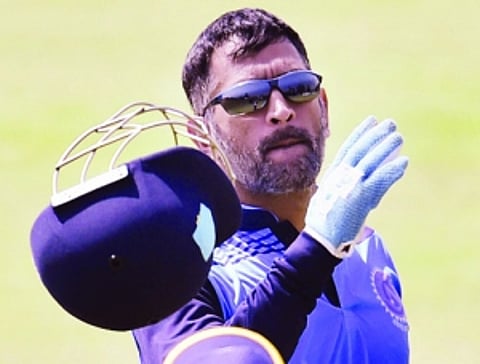

To excel in cricket today, a player must have talent, team spirit and tenacity. Dhoni possesses all these attributes. He is India's most eligible wicket keeper-batsman for the next World Cup
For true lovers of cricket all over the world, it has been really heartening that CSK Prasad has put to rest any speculation about Mahendra Singh Dhoni’s selection to play in the next ODI World Cup. Mahi, as he is popularly known, clearly stands out as India’s most eligible wicket keeper-batsman for the next World Cup. Should India win the next World Cup, as the whole country hopes, that would be Dhoni’s greatest moment of glory before he finally retires.
The biggest feature of Mahi’s cricketing career has been his ability to rise to the occasion, no matter how formidable the challenge and he has done that time and time again entirely on the strength of his abilities. He would go down in the history of cricket as one of the all-time greats.
Dhoni’s family hails from a small village in district Almora in Uttarakhand, but his parents and family have lived for several years in Ranchi. Consequently, he has not had the advantage of coming from one of the power centres of cricket, which have often promoted their local players far beyond their capabilities.
Without casting any aspersions, there have been several years when the heroes of yesteryear were consistently poor in their performance, but that never led to the question of dropping them and having them sit out to work hard and regain form. It, therefore, comes as a great surprise that questions are being raised about the continuation of Dhoni in the next World Cup in his capacity as India’s wicket keeper. Such speculation completely ignores the lightning speed and the agility with which this supremely talented player still whips off the bails in a fraction of a second and claims wicket after wicket by stumping. Nor is he lacking in his ability to dive or stretch out to hold on to difficult catches.
Mahi has always led from the front. Under Dhoni’s captaincy, India has reached unprecedented heights in every format of the game, but, of course, that should not be the criterion on which he should be retained till the World Cup in 2019. He should be considered only on the basis of his current potential and form.
Cricket in India has become an extremely competitive sport and there is, undoubtedly, formidable bench strength in every department of the game; Dhoni’s retention should be only on the basis of merit. There is today a substantial amount of money not only for the players but for anyone officially associated with cricket in this country. This fact often results in distorted decision-making and considerations other than ability in the selection and promotion of individuals. This is a far cry from the reality of 70 years ago, when India became independent and the national team consisted of players who earned very little, barring just a few from princely families.
This writer was coached by the outstanding all-rounder Dattu Phadkar, who made his debut in world cricket on the tour of Australia in 1947-48. In his very first appearance, he was top scorer for his team, hitting 51 runs against Bradman’s legendary 11, and captured three wickets for 14 runs. Despite his prowess and performance over the next decade and more, he never earned enough to rise to an income level above middle class.
Players in other countries too suffered a similar fate. Brian Statham of England, perhaps the most accurate fast bowler of all time, died in a state of poverty. When Freddie Trueman, the fiery fast bowler, who bowled in tandem with Statham in the 1950s, found out in 1989 about the latter’s financial problems, he organised two testimonial dinners to raise resources to help Statham. Today’s players fortunately get all-round adulation from the public with astronomical payments and anyone, who is a star in cricket, becomes wealthy in a short period of five years or less.
To excel in cricket today, a player must have talent, team spirit and tenacity. Dhoni possesses all three of these attributes and just because in some match or the other he has not been able to hit the ball all around the park in the amazing manner that he is known for, does not mean that his reliability as a superfast run scoring machine must now be questioned.
There have been many players in India and elsewhere who have retained their talent despite advanced years and even though the game is now much more competitive than in the past, and the need for top physical fitness is far more essential, Dhoni’s physical condition is in no way inferior to that of much younger players in the team. India has had a legend like the late Col CK Nayudu, who played first class cricket right till the age of 67, and on one occasion he was hit by a bouncer from Dattu Phadkar, lost a tooth, spitting it out with blood, but playing on to score over 60 runs. Dhoni has the same type of grit, and can continue without any decline in ability till at least the next World Cup when he would be 38 years old.
Even more important than Dhoni’s wicket keeping and batting ability is the enormous benefit he provides to his captain and the team as a source of instant cricketing wisdom at even the most difficult stages of a game. Virat Kohli and Rohit Sharma as captains fully appreciate the value of Dhoni’s guidance and advice from behind the stumps.
Over and above that he is a calming influence and a constructive spirit on the field, providing confidence and support to the entire team. While Captain Cool has never been obsessed by playing to the gallery, the expression of support from the selectors and the public at large would certainly boost Dhoni’s confidence and take him to greater heights of performance in the next two years. One can only hope that the demonstration of support for this unique player is vindicated by India winning the World Cup once again in 2019.
Dhoni’s success and the state of cricket in the country today provide a powerful lesson for other activities as well. Cricket in India is now governed by an ethic of competitive meritocracy. This has been responsible for India rising to the top of the table in the world. If we could neutralise the influence of deadening bureaucracy and the decimation of merit in decision-making, Indians would show that they can be the best in the world in other spheres of national endeavour as well. Today, unfortunately, there are very few centres of excellence in the country, relative to our size, which could spawn a culture of merit determining the recognition of individuals and institutions.
(The writer is former chairman, Intergovernmental Panel on Climate Change, 2002-15)