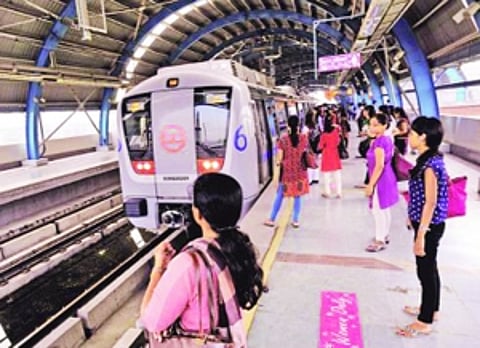

Government has taken a smart move by insisting on private participation in metro projects
The success of the Delhi metro, with its impressive construction schedule and implementation, led to rush among many Indian cities to build their own rapid transit systems. After years of delays, the lack of public transportation infrastructure began to impact the cities, as roads were simply not able to cope with the volume of traffic. Yet, the costs of building metro systems is immense. In an Right to Information reply, the Delhi metro said that the construction of one-kilometer of underground line for the third phase of the project costed Rs 550 crore in 2015. For overhead sections, the cost was approximately Rs 220 crore per kilometer. But with the metro now traversing through the heart of the southern part of the capital city, over 41 kilometres of track was underground, of the total 140-kilometres phase.
These costs can only be slightly less in other cities as the cost of land acquisition is lower over there. But with a highly skilled labour force, the cost of equipment and the inevitable delays afflicting the Delhi metro, costs across the 500-kilometres of metro rail projects under construction across over a dozen cities in the country, are beginning to skyrocket. Funding such projects is becoming expensive for the Union Government as well as for the deeply indebted State Governments. Uttar Pradesh alone is constructing metros in lucknow, Kanpur and Noida/Greater Noida and has proposed new systems in Agra and Varanasi. With the Narendra Modi Government’s plans for social sector spending set to increase, the costs of funding so many metro projects, while going on a necessary highway construction spree, is going to put more pressure on the exchequer.
The new policy outlined by the Government puts a more reasonable rate of economic return at 14 per cent. This realises to some extent the value addition a metro rail system will impart to a large city’s economy. But it will also puts on hold some vanity metro rail projects being dreamt by Chief Ministers. Refusal to sanction loss making projects and with an insistence on last-mile connectivity, also does in unviable lines and extensions. A controversial aspect is the provision for private participation either in the whole project, like the DlF-operated Gurugram metro or in unbundled components of the operation, such as fare collection. While there have been issues with some privately-operated metros, such the Airport Express in Delhi, with the erstwhile operator and the Government locked in a legal dispute, with the heady days of the mid-2000’s now a distant memory, one expects private operators to think through projects a lot more carefully, especially if they have to raise funds through the Bond market. But most importantly, the new metro rail policy urges the Indian cities to consider other public transport options such as trams, monorails and bus rapid transit corridors. These systems may not have the throughput of several trains an hour, but in some smaller cities, such as Indore, where a smart bus transit system is running, these make more economic sense because they are a fraction of the cost of expensive metro systems. But big Indian cities have no option but to build expensive and heavy transit systems if they are to survive economically. The new guidelines have been thought through well and should aid cities in planning their public transportation which needs to go forward.