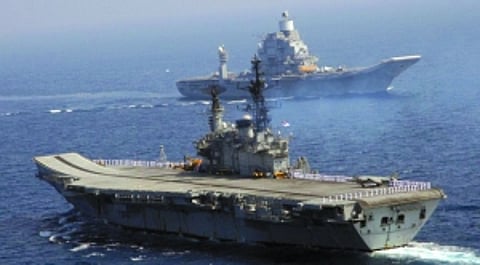

Though Arihant has happened at the right time, future projections of defence acquisitions and indigenous production need to be scaled up. Our maritime strength is meagre as compared to the Chinese fleet
Even after over a century and a half, Rudyard Kipling’s Great Game continues to be played, only the turf and the players have changed. The target, that is access to and consolidation in Indian Ocean remains the same, of course with different nuances.
In this context, our Prime Minister Narendra Modi’s forthcoming visit to Maldives to participate in the inauguration of the new presidency is most welcome and a step in the right direction. But coming after over three years of the earlier cancelled visit of 2015, a lot of ground will now have to be covered and without any further time to lose. After all, today, the Indian Ocean is no longer India’s ocean.
It is worth recalling that after becoming the number one trading partner of Africa, in its policy statement, China in 2015 had emphasised that it would seize the strategic initiative to effectively secure its overseas interests. Following this, we have seen heavy investments being made by China in our neighbourhood for the development of the Maritime Silk Route along with CPEC.
Simultaneously, development of the ports by China at Djibouti, Gwadar and Hambantota virtually completes a secure triangle around the Arabian Sea and a strategic positioning on the access routes to Red Sea and the Persian Gulf. Also, plans of the Chinese to develop Ihavandhoo as a deep sea port on an atoll in the Northern Maldives have since come to light. This location would virtually stand guard on the seven degree channel, the main navigational route from China and South East Asia for Europe and Gulf and carrying about $18 trillion in the terms of annual trade.
On top of this, very recently an agreement has been signed with Myanmar for construction of a multi-billion dollar port at Kyaukpyu , in the Rakhine state not far from Bangladesh. This Kyaukpyu special economic zone will be ultimately linked by rail/road to Kunming and provide access to the Bay of Bengal on the same pattern as Gwadar does to the Arabian Sea.
However, the Chinese plan of developing Sonadia into a port was cancelled by Bangladesh in 2017. But now they are showing their keenness on Payra port. This port in Bangladesh along with Kyaukpyu in Myanmar would be important locations on the
proposed Maritime Silk Route. In the given scenario, the great game as of now, seems to be going the Chinese way, as they can claim legitimate access to the Bay of Bengal as also to the Arabian Sea on either of our flanks. All these developments have serious implications for diplomacy in the neighbourhood as well as our navy.
Though Arihant has happened at the right time, future projections of defence acquisitions and indigenous production need to be scaled up. Our maritime strength is meagre as compared to the Chinese fleet. It is a historical fact borne out of the World War II and our own 1971 (INS Khukri was sunk by submarine PNS Hangool) that far more damage to enemy shipping is caused by submarines than any other vessel.
As such a fresh look in our priorities and strategy would be in order. For instance, Japan has established a maritime cordon against submarines and deploys almost 200, P-3 Orion and S-2 aircraft patrols for detection of submarines.
Satellite technology is being used these days to track enemy shipping and even the deeply submerged nuclear submarines. It is often said that there is now hardly any place left to hide the naval assets particularly the carriers.
In the given circumstances, it is high time that considering our expertise in space missions, we develop our own satellite based naval surveillance systems and are able to detect the threats well in advance for putting effective counter measures in place.
In the long run, it has to be left to our diplomats and the political executive supported by armed forces to create a strong and favourable geopolitical environment in our neighbourhood and the Indian Ocean region.
(The writer is a retired Delhi Police Commissioner and former Uttarakhand Governor